December 1, 2023

Three things you need to know about your student loans

"Going to college is one of the most significant decisions an individual will ever make. There are enormous 

opportunities that come with higher education, but there are also significant costs associated with pursuing a degree. 

Most college students, if not all, need financial assistance to pay for tuition, books, and other fees. This is where 

student loans come in handy."

"Student loans are a type of financial aid that supports students across the globe in achieving their dreams of 

obtaining a college degree. While student loans can be a great resource, they can also become a burden if you don't 

understand how they work. In this blog post, we will share three things you need to know about your student loan 

to make informed decisions and avoid unnecessary debt."


e: michael.morris@thesixthdegreemedia.com

w: thesixthdegree.media

  1. There are different types of loans
  2. What are the interest rates?
  3. How will you pay it off?

Get more info on how to Set yourself up for success at: 

October 27, 2023

Downsizing without filling the landfill

 My husband and I are in the process of selling our house and moving furniture and belongings into storage while we wait for our desired home to hit the market. So we have spent the last two weeks sorting through stuff we accumulated from 32 years in the same house plus possessions, photos, letters and more from a lifetime of accumulation. We are deep into "Swedish Death Cleaning!" Check out the book:

The Gentle Art of Swedish Death Cleaning: How to Free Yourself and Your Family from a Lifetime of Clutter by Margareta Magnusson https://www.goodreads.com/book/show/35297297-the-gentle-art-of-swedish-death-cleaning

Read about lots of options for giving away or selling your stuff:

My Quest to Downsize Without Throwing Anything Away

A big old house full of belongings — could I find them all a new life?

https://nymag.com/intelligencer/article/how-we-downsized-and-sold-our-house-without-creating-waste.html 

We still ended up filling our trash and recycling cans many times over. 

October 25, 2023

Time to start holiday shopping

To spend less money on holiday shopping, get it done ASAP

Michelle Singletary, personal finance writer for the Washington Post, says it's time to start holiday shopping to get the best deals. Yikes! It's not even Halloween. I cringed when I saw Christmas decorations and displays in a store recently. Sigh.  But if you are one of those people who buys a lot of holiday gifts... now is the time. 

It's also a good time to remind readers that so many gifts are unappreciated by the recipient and returned to the retailer and that gifts of experiences are remembered and appreciated more than gifts of goods.

Singletary suggests there are five types of shoppers. Which are you, and has it served you well?

  1. Overspender
  2. A gift for you, one for me

  3. Bargain hunter

  4. Last-minute shopper

  5. Early bird

 Check out the full article for details.  https://www.washingtonpost.com/business/2023/10/25/spend-less-money-holiday-shopping-get-it-done-asap/?template-name=%7B%7Bletter.config.name%7D%7D&utm_campaign=wp_personal_finance&utm_medium=email&utm_source=newsletter&wpisrc=nl_finance

How do you compare financially to Americans overall?

 Among U.S. families, 66% own their home, 58% own stocks, 54% have a retirement account, 45% have credit card debt and 35% have a car loan, according to the Fed's latest Survey of Consumer Finances.

Of course, no one is really average but the figures help you get an idea of where you stand. 

"Net worth. The typical (or “median”) net worth—meaning the value of all assets minus all debt for those American families halfway down the wealth spectrum—was $192,700 in 2022.  But the average (or “mean”) wealth, which measures America’s total net worth divided by all households, stood at $1,059,470. This is a classic example of skewness, with a small number of outliers—in this case, America’s wealthiest families—skewing the results higher."

Income. Skewness also shows up in pretax family income. As of the latest survey, the median (mid-point) household income was $70,260, while the average was twice as high, at $141,390. Houshold income is different from family income because households include singles whereas families are composed or two or more individuals which means the potential for two (or more) earners. 

Stocks. 58% of U.S. families were invested in the stock market, up from 48.9% nine years earlier. 

Real estate. 66% of families owned their primary residence, up from 63.7% six years earlier, but below the peak of 69% in 2004 (before the 2008 financial crisis).

Retirement accounts. 54.4% of families have a retirement account. Even in the age group where retirement accounts are most widespread—those ages 45 to 54—they’re held by just 62.2% of households. Those ages 65 to 74 had median retirement account balances of $200,000, enough to generate $670 in monthly income, assuming a 4% withdrawal rate.  

Credit cards.  When the data were collected... "credit card balances in inflation-adjusted terms are at their lowest levels since the 1990s. In 2022, 45.2% of families had card debt, down marginally from 2019, with a typical balance of $2,700 and an average balance of $6,120. Credit card debt is the most common form of debt, ahead of home loans, which 42.2% of families have, and car loans at 34.7%. Overall, 77.4% of families have some form of debt." However, the most recent data (mid-2023) show increases in the number of households with credit card debt and the amount of debt. 

Education loans. Roughly a fifth of families have student loans, with a typical balance of $24,500 and an average balance of $46,980.  

Thanks to Humble Dollar https://humbledollar.com/ blogger Jonathan Clements for this summary.  More details are available at: https://humbledollar.com/2023/10/by-the-numbers-2/?utm_source=mailpoet&utm_medium=email&utm_campaign=another-ses-test_7

September 10, 2023

Time to ditch food expiration dates

 Americans waste a colossal amount of perfectly good food. 

This is bad because resources and money are being wasted while contributing to climate change due to methane generated by food in landfills. 

Stop throwing away good food!

Food Expiration Dates? What a Waste By Josh Zumbrun in The Wall Street Journal, Sept. 8, 2023 explains the history behind food packaging dates and why they are so misleading.

'Contrary to a common perception, “those dates are not about safety, that’s not why they’re there, that’s not what they’re doing” says Martin Wiedmann, a professor of food safety and food science at Cornell University. “For many foods, we could completely do away with it.”'

According to Zumbrun, "The dates originated as a coded system for manufacturers to communicate to retailers when to rotate stock."

"The U.S. Department of Agriculture has estimated that 31% of the available food supply goes uneaten: Retailers discard 43 billion pounds of food annually, consumers a further 90 billion. That’s 387 billion calories of lost food, which the USDA says works out to 1,249 calories per American a day." 

It’s hard to determine exactly how much of that waste owes to labels, but probably more than most people think. ReFED, a nonprofit that works to reduce food waste, has used data from kitchen diaries to estimate annual U.S. food waste because of labeling concerns as nearly 7 billion pounds. There is reason to think this is an undercount. In a grotesquely amusing study, households that kept such diaries reported tossing 8.7 pounds of food a week, usually saying it was inedible or spoiled. Then researchers literally dug through their trash, and determined that 68% of the food was probably edible. Consumers might not even realize that they’re junking perfectly good food not because it’s bad, but because they are putting too much faith in expiration dates."

August 16, 2023

Traditional Medicare doesn't cover vision and dental

"Traditional Medicare doesn’t cover common dental procedures, such as cleanings, fillings, extractions, dentures, dental plates and other dental devices. Medicare also doesn’t cover the cost of eyeglasses, lenses or contacts" writes Richard Conner in the Humble Dollar Blog:

https://humbledollar.com/2023/08/what-medicare-misses/?utm_source=mailpoet&utm_medium=email&utm_campaign=another-ses-test_7

Pay attention to your dental and vision health before retirement. 

If your employer funds all or part of your dental and vision insurance, use those benefits to their fullest before you retire

"Fund a health savings account, or HSA, during your working years. You get a tax deduction for the amount you contribute, you can invest the money you save, and the earnings grow tax-deferred. When the money is used to pay for qualified medical expenses, the withdrawal is also tax-free."

"Some Medicare Advantage plans provide dental and vision coverage. What if you choose traditional Medicare? Consider purchasing private dental and vision insurance."

In his article Conner provides extensive suggestions and information if you need to buy private coverage. 

Maui Wildfires: What would you do if you had toquickly flee your home?

"If you had to quickly flee your home and had just enough time to grab some important things, could you put your hands on vital financial documents? 

Climate change has put many people in the path of major natural disasters. Fires, floods, hurricanes and wind storms are devastating communities. The disaster in Hawaii is just the latest reminder to get our financial houses in order." 

Read:

How to protect your financial life from wildfires, extreme weather

By Michelle Singletary

https://www.washingtonpost.com/business/2023/08/11/protect-financial-life-extreme-weather/?template-name=%7B%7Bletter.config.name%7D%7D&utm_campaign=wp_personal_finance&utm_medium=email&utm_source=newsletter&wpisrc=nl_finance

As of mid-August 2023, "there had been 15 confirmed weather/climate disaster events in the United States this year with losses exceeding $1 billion each, according to the National Centers for Environmental Information. Damage from 2022 disasters totaled $165.1 billion."

"Get a safe that’s waterproof, fire-resistant and light enough to carry. Keep all your household’s important financial documents in this box, including your passport; insurance policies; extra checks; a copy of your driver’s license; your Social Security card (or at least write down the number); bank, investment and credit card account numbers; and key legal documents such as wills, marriage and birth certificates, and the titles to your home and vehicles." 

I keep these items in a credit union safe deposit box. Not sure what would be left if fire is as intense as the Maui fires. I read that one Maui couple kept thousands of dollars in a safe that was left behind. All that was left was ashes.

You should include some cash because ATMs may not be available or may not work.

"In addition to keeping your paperwork in a safe, make photocopies of your documents and place them in a safe-deposit box or give them to a trusted relative or friend who does not live in the same area you do."

"You can also back up your data to cloud-based services such as Google Drive or Apple’s iCloud. Be sure to consistently back up your data to the cloud."

"With your smartphone, take pictures of your big-screen televisions, computers, furniture, heirlooms, etc. You want proof of the expensive stuff you own."

"record a video of the items in your home. Record model and serial numbers. Then, of course, download it for safekeeping in the event you have to prove to an insurance company what items you lost in a disaster."Do this today.

Do you have sufficient insurance?

Call your insurance agent. Will your policy replace the full value of your possessions?

If you are at risk of flooding, check my blog posts on flood insurance. Keep in mind that many Americans live in areas subject to flood but NOT on federal flood maps. See blog posts on flooding. 

Earthquakes are NOT covered by HO insurance. See blog posts on earthquake insurance. 

The fastest-growing American cities are also some of the places with the worst climate-change effects

Finally,What are YOU doing to urge your members of congress to address the causes behind our changing climate. Check out the Citizens Climate Lobby: https://citizensclimatelobby.org/


August 7, 2023

Is my Retiement savings on track?

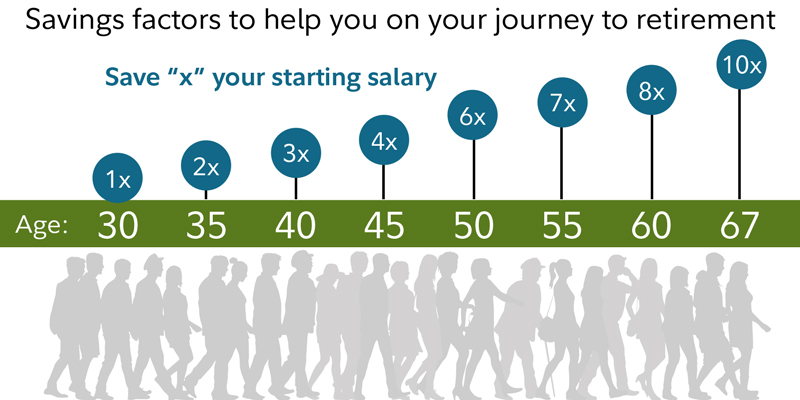
 While there are many variables affecting how much you will need to live on in retirement, no one wants to be caught short. You can borrow money for college but not for retirement. (aside from the option to take a reverse mortgage against your house). Fidelity investments provides some aspirational guidelines to help. 

"Our savings factors are based on the assumption that a person saves 15% of their income annually beginning at age 25 (which includes any employer match), invests more than 50% on average of their savings in stocks over their lifetime, retires at age 67, and plans to maintain their preretirement lifestyle in retirement."

By age 30 you should have accumulated one time your salary; If you're not there yet it may be time to boost your savings. And when I refer to "saving" for retirement I really mean investing.  

Details at: https://www.fidelity.com/viewpoints/retirement/how-much-do-i-need-to-retire


Savings factors to help you on your journey to retirement.  By age 30, have 1x your salary, age 50, 4x and age 60, 8x.

Medicare Advantage vs. Traditional Medicare

 One of the most important decisions older Americans need to make when they reach 65 (or older if still covered by employer health insurance) is traditional Medicare or Medicare Advantage.Once you reach age 65 almost all Americans are covered by Medicare Part A at no cost. But you need to supplement that coverage.

The primary argument in favor of traditional Medicare is the broad acceptance. You can get care from any facility in the U.S. that accepts Medicare payment. With most Medicare Advantage Plans you are limited to designated service providers that participate in that plan. 

Due to the coinsurance and deductibles with traditional Medicare, you really need to buy a supplement plan and prescription drug coverage (Part D). If you aren't taking prescription drugs when you sign up and decide to skip a Part D plan, you will pay extra if you wait to sign up.

Some Medicare Advantage Plans offer coverage with a $0 monthly premium which can seem very attractive but you need to do your homework and decide on your personal priorities. Whether or not you pay a premium, Advantage plans typically cover eye, hearing and dental exams and dental exams as well as memberships in athletic facilities and other benefits not included in traditional medicare. 

 Check out the

AARP Medicare Enrollment℠ Guide 

https://www.aarp.org/membership/benefits/health/aarp-medicare-enrollment-guide/

and comments pro/con on each option:

https://humbledollar.com/voices/which-is-better-traditional-medicare-or-medicare-advantage/

June 6, 2023

Got a Scholarship? Write a Thank You Note!

Receiving a scholarship is a great honor. Don't forget the important step of writing a thoughtful thank you to the donor.

A well written thank you letter not only shows how much you appreciate the financial support, but more importantly it also helps to ensure that the donors continue to offer their scholarships to future students.
https://resume.io/blog/how-to-write-a-scholarship-thank-you-letter


Financial Planning for Women does not sell, rent, loan, lease or otherwise provide any personal information collected at our site to any third parties.