Showing posts with label consumer action. Show all posts

March 8, 2022

Six Key Lifestyle Changes Can Help Avert the Climate Crisis

 Less Stuff, More Joy! “Take the Jump”

Six Key Lifestyle Changes Can Help Avert the Climate Crisis

In February the Intergovernmental Panel on Climate Change (IPCC) issued its “bleakest warning yet,” saying the climate crisis was accelerating rapidly with only a narrow chance left of avoiding its worst ravages. But don’t give up hope.

Governments and individuals making small changes can have a huge impact in reducing carbon emissions. These six steps could cut global emissions by between 25% and 27%:

1.      Eat a largely plant-based diet, with healthy portions and no waste

2.      Buy no more than three new items of clothing per year

3.      Keep electrical products for at least seven years

4.      Take no more than one short haul flight every three years and one long haul flight every eight years

5.      Get rid of personal motor vehicles if you can – and if not keep hold of your existing vehicle for longer (or go electric)

6.      Make at least one life shift to nudge the system, like moving to a green energy, insulating your home or changing pension supplier

‘Taking The JUMP’ is to try the shifts mentioned above for 1, 3 or 6 months. Even if you can’t keep to it 100%, you can still ‘take The JUMP’ and just do what you can.

We'll offer tips, encouragement and people you can speak to help along the way. Check out: https://takethejump.org/ 

Free Pxclimateaction Climate Change photo and picture 

June 17, 2021

How much are you spending on bottled water?

The Story of Bottled Water

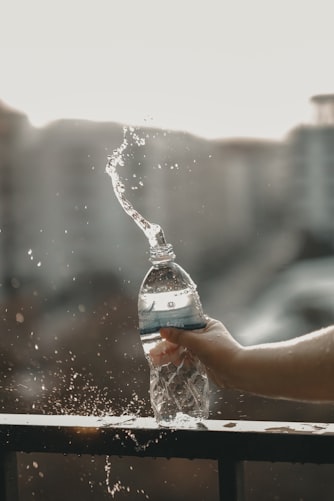
For those of us who remember life without bottled water, it is sad, pathetic, and frustrating when consumers spend money on water packed in a throw away plastic bottle. The bottle is made from petroleum and shipped across the country (wasting more petroleum), and then 80% of the bottles end up in landfills or incinerators. Even worse, much of the supposedly recycled bottles are shipped to developing nations like India (wasting more petroleum in the process) where they add to the pollution problem. While consumers routinely claim to be immune to advertising, bottled water is a classic example of “manufactured demand,” using scare techniques and images of pure fantasy to entice buyers. Pepsi’s Aquafina and Coke’s Desani are simply filtered tap water sold at 2,000 times the price of tap water! Despite its advertising claims and images of pristine sources, Fiji water is lower quality than Cleveland’s tap water. Imagine paying 2,000 times the price of gas for your car! Yet consumers succumb to this insanity daily. 

Logan, UT has some of purest water on the planet coming out of our taps. Don’t be a schmuck. 

Save your money and the environment; use a steel water bottle. 

Watch the 8 minute video and kick the bottled water habit: http://storyofstuff.org/movies/story-of-bottled-water/

April 7, 2021

Trump Steered Supporters Into Unwitting Donations

"Online donors were guided into weekly recurring contributions. Demands for refunds spiked. Complaints to banks and credit card companies soared. But the money helped keep Donald Trump’s struggling campaign afloat." Writing for the New York Times,


February 3, 2020

Effortless Environmentalism: Some easy ways to live more gently oon the earth

"If 2019 is truly “the year we woke up to climate change,” then 2020 should be the year we start actually doing something about it. Because we are very nearly out of time."
Effortless Environmentalism


by Margaret Renki for The New York Times

"Think of these suggestions as baby steps on the path toward a growing commitment to change."

"Vote. The climate crisis is the one issue that matters most in this election, and not just because the survival of the human race depends on it."

"Reframe your relationship with bugs. Insects are the bread and butter of the natural world, but they are dying out. Think of your yard as ground zero of the entire local food chain." 

"Cultivate a glorious mess. Nature isn’t supposed to be tidy, and its messiness is purposeful. Fallen leaves fertilize the trees they fell from and simultaneously provide habitat for a whole host of insects, amphibians and reptiles."
KILL your leaf blower which is an environmental disaster due to noise and air pollution!

"Eat better. Agriculture accounts for about a third of greenhouse gas emissions, primarily through deforestation, the use of petrochemical fertilizers and methane production by livestock. To mitigate its effects, eat less meat and fewer dairy products."

"Shop your closet. In addition to its manifold human costs, “fast fashion” — cheap clothing designed to be temporary in the age of Instagram — is a significant cause of environmental degradation."

"Put your money where your values are. Support a fierce environmental nonprofit through automatic monthly drafts" 

"Pay for your sins. Avoiding air travel is one easy way to lower your carbon footprint significantly, but you can also buy carbon offsets for the flights you can’t avoid."

"Lighten up on the plastic. It’s almost impossible to avoid single-use plastics altogether, but a one-time investment in reusable versions of your most frequent purchases can reduce your dependence on them."

"Don’t hold yourself to an unrealistic standard of purity. Just as it’s O.K. to eat the birthday cake, it’s O.K. not to be a perfect steward of the earth."

Read the details: 
 https://www.nytimes.com/2020/01/13/opinion/earth-environmentalism.html?smid=nytcore-ios-share

October 27, 2019

Amazon sells clothes from factories other stores shun

"After a 2103 factory collapse killed more than 1,100 people in Bangladesh, most of the biggest U.S. apparel retailers joined safety-monitoring groups that required tham to stop selling clothing from factories that violated certain safety standards" according to Wall Street Journal writers J. Scheck, J. Emont, and A. Berzon (front page WSJ 10/24/19). Except Amazon which sells clothing from dozens of Bangladesh factories that violate basic safety for employees.
So please... think twice before buying clothing on Amazon.

October 23, 2019

Why waste money on bottled water?

Almost all Americans have access to clean water. According to Consumer Reports, More than 90% of Americans on municipal systems have pure water. Yet we spend more than $30 BILLION per year on water that is no cleaner than our tap water. In fact, numerous bottled water companies (Aquafina and Dasani)draw their water from municipal supplies! Just think was $30 billion dollars could buy!

As I often pick up trash along sidewalks, hiking trails and bike paths, the most common litter is plastic water bottles. While supposedly recyclable, the market for plastic recycling has almost evaporated since China decided to stop importing our waste.

All the microplastics going into our bodies and the environment is another reason to use a refillable water bottle.

Check out the November 2019 issue of Consumer Reports with its special report: "Is bottled water safe?"

May 27, 2019

Who pays for Trump's tariffs? You do of course!

Here is one example from Planet Money that illustrates the point:

"In early 2018, after the American company Whirlpool complained about foreign competition, the Trump administration implemented tariffs on washing machines imported from all over the world. It’s a 20% tariff on the first 1.2 million washing machines sold a year and a 50% tariff on every one after that."

"While these tariffs were imposed on foreign manufacturers, the study by Flaaen, Hortaçsu, and Tintelnot, like study after study before it, finds it’s ultimately U.S. consumers who pay. New washing machines in America got about 12% more expensive. That’s not too surprising."

"What is surprising is that dryers also got more expensive even though they weren’t subject to the tariff. That’s because washers and dryers are in econospeak “complementary goods.” They are more valuable together and are typically bought at the same time. “Before the tariffs, most manufacturers were pricing paired washer and dryer models at the exact same sticker price,” Felix Tintelnot, a co-author of the study, says. “This pricing strategy was maintained after the tariffs… so the full effect of tariffs on prices is only visible after factoring in the price of the complementary good – dryers.”

"The clear losers in the study are Americans who needed to buy a washing machine or dryer in the last couple years. But, because the tariffs made foreign washing machines more expensive, it made American-made washing machines more appealing — and it convinced LG, Samsung, and Whirlpool to create about 1,800 jobs making washing machines and dryers in the US. Cool, right? Not really. After taking into account the extra money paid for these appliances because of the tariff, those 1,800 jobs ended up costing Americans about $815,000 per job every year."

Get more details and examples at: https://www.npr.org/sections/money/2019/05/21/725135293/more-tariffs-on-china-more-head-scratching-from-economists?utm_source=npr_newsletter&utm_medium=email&utm_content=20190521&utm_campaign=money&utm_term=nprnews

Bottom Line: Trump's Tariffs hurt U.S. consumers! 

May 2, 2019

Consumer Financial Protection Bureau head more interested in helping corporations than protecting consumers

"Kathy Kraninger gave her first speech as director of the Consumer Financial Protection Bureau (CFPB) at the Bipartisan Policy Center in Washington, D.C., in April. We were alarmed to hear Kraninger voice an overall vision for the CFPB that appeared antithetical to its core function of “enforcing federal consumer financial laws.” Kraninger stated that she was concerned with the CFPBs’ role in creating a “regulatory burden” for the companies under its supervision. She conveyed her intent to focus the Bureau on “prevention of harm” through consumer education, while limiting its powerful examination and enforcement tools to “purposeful” uses.
“Given Director Kraninger’s announced focus on education over consumer protection, consumer advocates are determined to educate the new director about the need for robust Bureau oversight and enforcement to hold financial companies accountable for harmful practices,” Consumer Action’s Deputy Director for National Priorities Ruth Susswein said." Source: Consumer Action
https://www.consumer-action.org/news/articles/consumer-action-insider-may-2019/?eType=EmailBlastContent&eId=c4ee986f-51de-4c8a-a008-0d1eaef48ad2#Topic_08

March 14, 2019

Wells Fargo CEO got 5% pay raise despite all the company's anti-consumer & illegal behavior!

The Wall Street Journal (3/14/19) reports that Wells Fargo CEO Timothy Sloan received (note I did not use the verb "earned") "$18.4 million in compensation for 2018, including a $2 million incentive award."
WOW! Can you believe #1 that level of compensation and #2 in the face of all the illegal and anti-consumer practices of that nefarious company? Writer Maria Armental also reports: "The pay disclosure comes a day after the San Francisco bank received a rare rebuke from a top regulator, minutes after Mr. Sloan finished testifying before Congress, and as regulators consider whether to force out top executives or directors."
Yikes! Get rid of those guys! It's time for a clean sweep at WF. If you aren't familiar with all the many misdeeds and misbehaviors of Wells Fargo executives, simply search online for "Wells Fargo Scandals."
And we wonder why we have an escalating gap between the 1% and the rest of us!
WF execs and board members are probably the same people who argue against raising the minimum wage!
If you are STILL a Wells Fargo customer... WHY?!?

May 10, 2018

More Bad News About Wells Fargo

As reported in The Wall Street Journal (5/10/18, p. B1): "Wells Fargo & Co. has acknowledged that it pocketed fee rebates that should have been passed on to a public pension fund in Tennessee while acting as its trustee...."
Wow! What hasn't this bank done to screw its consumer and corporate customers? Drop this bank like a hot potato. Find a credit union that will treat you right. Need I say more?

April 30, 2018

Trump eviserates the Consumer Financial Protection Bureau

Does anyone remember the 2008 financial crisis? Do you recall the major causes of the global financial meltdown? Egregious behavior by the banks and mortgage lenders! So Congress passed the Dodd-Frank Wall Street Reform and Consumer Protection Act in 2010. In addition to regulating banks and Wall Street, Dodd-Frank established the Consumer Financial Protection Bureau (CFPB). From its inception to April 2017 the CFPB "returned almost $12 billion to 29 million consumers and imposed about $600 million in civil penalties."
Now the Trump White House is trying to destroy the CFPB (mainly because the bill was signed by President Obama) but also because, rather than cleaning up the swamp in D.C. Trump hires former wall Street big guns to run the country.
Trump appointed Mick Mulvaney, White House budget director for a second full-time job as acting director of the Consumer Financial Protection Bureau. Mulvaney sure has the consumer interest at heart. He epitomizes the swamp; he stated that when he was a member of Congress, he would only talk with lobbyists who were donating money to him. Forget lobbyists for consumer and environmental organizations: no money; no access!
Mulvaney is making massive changes to the CFPB according to The Wall Street Journal and other reliable sources. He is following Trump's direction to gut the consumer bureau... and deepen the swamp.

April 21, 2018

Wells Fargo Bad behavior...once again

According to Ken Sweet, writing for the Associated Press,
"Wells Fargo will pay $1 billion to federal regulators to settle charges tied to misconduct at its mortgage and auto lending business, the latest punishment levied against the banking giant for widespread customer abuses."
The bank "has admitted to a number of abusive practices across multiple parts of its business that duped consumers out of millions of dollars."
If you are still a Wells Fargo customer... WHY? It's time to join your local credit union!

April 5, 2018

Don't pay for extended warranties

"Cost of a three-year extended warranty for a dishwasher: $157.97.
Average cost of a dishwasher repair: $159.
The fact that service contracts often cost about the same as a repair is just one reason extended warranties — also known as service contracts and protection plans — are hardly ever a good deal." 
"Not actually extended: Despite the name, the Federal Trade Commission says many “extended” warranties go into effect at the same time as the manufacturer’s warranty. Plus they contain language requiring you to tap the manufacturer’s warranty first." Why pay for duplicate coverage?
"Lots of exclusions: Complaints to the Better Business Bureau show that many consumers are frustrated to find that their extended warranty won’t cover their problem because of  'exclusions' in the fine print of the contract. For example, some service contracts won’t cover routine maintenance, accidental damage or preexisting conditions. Others exclude specific parts."
"Deductibles and fees":  many warranties charge deductibles or service fees on every claim.
"Must mail the product": "some extended warranties require you to ship your broken product somewhere for repairs." That’s an extra cost plus time without the product.
"No servicer selection": some contracts require that you use a specific repair facilitythat may not be convenient or reliable.
"Shop must get permission": repair shops may have to obtain preapproval from the warranty company before making repairs, further delaying the process.
"Third-party companies: Many extended warranties are sold by retailers and backed by third-party companies, rather than by the manufacturer of the product. Some consumers have complained that the salesperson never “activated” their service contract, so the warranty company refused to honor it. Other times, these third-party warranty companies have gone out of business, leaving consumers with nothing for their money."
Don't be pressured or scared by the sales clerk to buy unnecessary "protection." 
Do your research before you buy to choose reliable products from ethical companies. 

March 21, 2018

Unauthorized charge for Amazon Prime?

I was surprised to find a charge for Amazon Prime membership on my credit card. I occasionally order from Amazon but never joined Prime. When I called my credit card company to dispute the charge I was told that this happens all the time to Amazon customers. The credit card rep told me to call 888-280-4331 and that it would be easy to get the charge removed. WOW! I didn't have to wait on hold or even have to speak to a person to get the charge removed. So, check your credit card bills EVERY month and keep this phone number handy in case this happens to you.

September 15, 2017

Republicans aim to weaken Consumer Watchdog just as Experian data breech affects 143 million Americans!

CFPB in congressional crosshairs, experts say
The Consumer Financial Protection Bureau, created as part of the post-crisis Dodd-Frank Act, will be unable to retain its full power to rein in Wall Street, even if its Democratic director, Richard Cordray, remains in his post, experts say. The Republican-dominated Congress has repeatedly taken aim at the agency's mandate and budget.
Gee! Doesn't this make lots of sense just a Experian revealed that it failed to protect 143 million Americans from having their personal data stolen that will be used for ID theft.  The data breech occurred this summer and it took two months before the problem leaked out to consumers and the news media!
Let's hope that more than a few Republican Congress members are victims of this data breech.

May 15, 2017

The latest internet scam

"Your love of a good deal could be a deal breaker. Fake gift cards and coupons for Lowe’s, Bed Bath & Beyond, Home Depot, Target and IKEA (phew!) have infiltrated the internet. On Facebook, the phishing scam is taking the form of a $50 coupon for Lowe’s and a $75 one for Bed Bath & Beyond. (Check out photos of the bogus bucks here and here). The coupons appear as posts and ads on the social media site. Once you click on them, you’re directed to fake websites or survey pop-ups that instruct you to answer a few questions in order to “earn” the coupons. The surveys, predictably, ask for your personal information (in order to steal your identity, and yada, yada, the rest is history). The Better Business Bureau (BBB) is telling consumers to beware of pop-up-type offers and to “watch out for a reward that's too good to be true” because “few businesses can afford to give away $50 gift cards for completing a few questions.” They also caution that it’s easy for scammers to mimic a company’s website by tacking on a company’s logo, using its letterhead or making the website address (URL) look similar. If you’re wondering about a particular offer, visit the company’s real website and see if it’s listed there. And remember, $75 off nothing equals...nothing!"
Source: 
A Consumer Action News Alert • May 2017 • www.consumer-action.org
SCAM GRAM is Consumer Action’s monthly e-newsletter alerting you to the dirtiest players in the world of tech fraud, credit card scams, ID theft and general con-artistry. Don’t be fooled by liars, cheats and crooks—wise up with SCAM GRAM!

April 23, 2017

Got credit card complaints? Call your card issuer!

"The Consumer Financial Protection Bureau received more than 26,000 complaints regarding credit cards last year, with billing the most common reason. But intense competition in the industry means credit card companies can be responsive if cardholders call." Read :

Here’s proof that disputing your credit-card bill could be worth it

http://www.marketwatch.com/story/heres-proof-that-disputing-your-credit-card-bill-could-be-worth-it-2017-04-13
The CFPB is the consumer's best friend in the financial services marketplace yet it is under attack by the Trump administration.  How soon politicians have forgotten the horrors and agony of the 2008 global financial meltdown caused by banks and mortgage lenders. Check out the CFPB's website and learn how the agency, created in the aftermath of the financial disaster, can help you and your family: https://www.consumerfinance.gov/. The CFPB is a "U.S. government agency that makes sure banks, lenders, and other financial companies treat you fairly"

December 26, 2016

Fake news and financial misinformation

Our political process is suffering from an abundance of fake "news" stories designed to sway public opinion and votes. Fake news is proliferating and being absorbed without question by people who have failed to learn critical thinking skills. By sticking only to news sources that agree with one's political beliefs, too many Americana are believing political stories that are false.
Unfortunately, fake news is making its way into the financial arena. The reliable website, the Squared Away Blog recently provided an example of fake news with both political content and consumer ramifications. Check out: Financial Misinformation Shared Online at http://squaredawayblog.bc.edu/squared-away/financial-misinformation-shared-online/#comment-705394. BE SKEPTICAL! Ask yourself if there might be a political or financial gain behind a news story. Don't take for granted what you read on the internet or what your friends sends you via email. Don't just blindly pass along Facebook posts. Take a deep breath and tell yourself "Wait a minute! What is the source? How can I verify this information?" One resource is http://www.factcheck.org a resource from the non-partisan Annenberg Public Policy Center. Start the new year with the mantra: I WILL be skeptical and aware that fake news is proliferating. I WILL check out a variety of credible sources.

December 13, 2016

More reason to ditch Wells Fargo bank

Today (12/13/16) The Wall Street Journal reported that "U.S. regulators slapped Wells Fargo with new regulatory sanctions, saying the firm failed to address alleged 'deficiencies' in a plan to manage its own bankruptcy without a taxpayer bailout." It appears that the executives running the bank are pretty clueless as reporters Tracy and Glazer wrote: the rebuke was "another black eye for a bank that is still reeling from a scandal over its creation of bogus customer accounts. Even more stinging: the news was akin to failing a make-up test as the San Francisco bank had failed an initial test in April."
Consumers have so many choices for where to get banking services; why would anyone stick with Wells Fargo after the way it has mistreated its customers AND low-paid employees who were forced to implement the egregious policies. Further, the bank has fired many of those employees when the top decision makers should be the ones losing their jobs, pensions, and termination perks.
Consumers: check out a credit union near you!

September 22, 2016

Dump Wells Fargo!

If you bank with Wells Fargo it's time to dump that scandal-plagued institution and find another bank, or better yet, a credit union. Why would any consumer continue doing business with a bank that defrauds its customers? The scandal has been front page news in The Wall Street Journal for the past week. Bank policies resulted in high pressure on low-paid employees to con customers into buying additional bank products they didn't really want and even making up fictitious customer accounts to make it appear as if the bank were growing.  It's really sad the CEO John Stumpf is collecting an outrageous salary while the bank has now fired the low-paid employees that were subject to pressure to produce or lose their jobs!
I know from experience that it is a time-consuming process to change financial institutions, especially when you have automatic deposits and payments but it is absurd to give this bank your business now that it's egregious policies (toward both customers and low-level employees) is public.
"Cross-selling," encouraging customers to buy other bank products, is common in the industry but WF took the practice to fraudulent extremes and now is punishing their employees who had no choice. The head of the unit that perpetrated this practice got a $125 million payout and is being allowed to retire with full benefits! The fired employees are out of a job for doing what their bosses insisted they do!
Almost everyone qualifies to join a credit union, financial institutions that are member-owned rather than stock holder-owned. Virtually every research study that has compared banks and credit unions on interest rates paid on savings and rates charged for loans has concluded that consumers are better off with a credit union than a bank.
Sometimes consumers feel helpless to bring about change. But this one is simple. DUMP WELLS FARGO! There are lots of much better options! If you stay with this bank you are voting for more of the same egregious behavior!
Read the Washington Post editorial (9/22/16): "Accountability at Wells Fargo" at the Salt Lake Tribune's website: http://www.sltrib.com/opinion/4384134-155/washington-post-editorial-accountability-at-wells
and Washington Post columnist Dana Milbank's opinion: "Wells Fargo: Too big to fail, too arrogant to admit it" https://www.washingtonpost.com/opinions/wells-fargo-too-big-to-fail-too-arrogant-to-admit-it/2016/09/20/5c7ee1fe-7f6e-11e6-9070-5c4905bf40dc_story.html
Financial Planning for Women does not sell, rent, loan, lease or otherwise provide any personal information collected at our site to any third parties.