
Showing posts with label pre-retirement; retirement planning. Show all posts

August 7, 2023

Is my Retiement savings on track?

 While there are many variables affecting how much you will need to live on in retirement, no one wants to be caught short. You can borrow money for college but not for retirement. (aside from the option to take a reverse mortgage against your house). Fidelity investments provides some aspirational guidelines to help. 

"Our savings factors are based on the assumption that a person saves 15% of their income annually beginning at age 25 (which includes any employer match), invests more than 50% on average of their savings in stocks over their lifetime, retires at age 67, and plans to maintain their preretirement lifestyle in retirement."

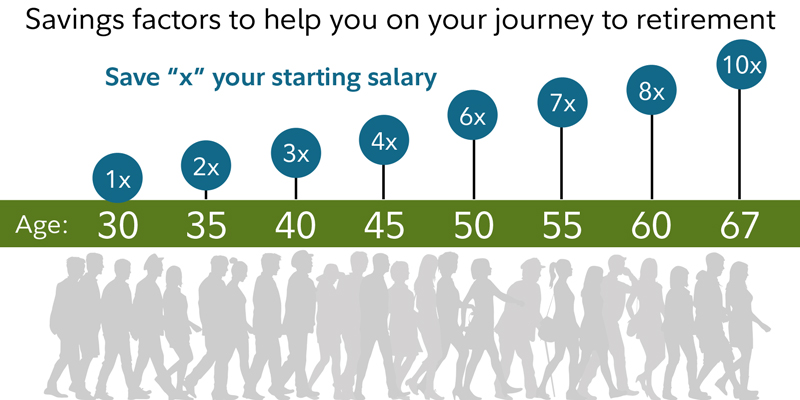
By age 30 you should have accumulated one time your salary; If you're not there yet it may be time to boost your savings. And when I refer to "saving" for retirement I really mean investing.  

Details at: https://www.fidelity.com/viewpoints/retirement/how-much-do-i-need-to-retire


Savings factors to help you on your journey to retirement.  By age 30, have 1x your salary, age 50, 4x and age 60, 8x.

March 20, 2023

It's Tax Time... and also retirement investing time

 In 2021, 85% of all American households made zero contributions to Individual Retirement Accounts (IRAs), whether traditional IRA or Roth IRA. anyone with earned income and non-earning spouses with a working spouse, can contribute up to $6,000 for the 2022 tax year. Persons 50 and older can invest an additional $1,000 in an IRA. 

Traditional IRAs offer a tax deduction at tax time but withdrawals in retirement are taxed. Roth IRAs provide no immediate income tax deduction but withdrawals in retirement are tax-free. Income limits for Roth contributions are $129,000 for single filers and $204,000 for married joint filers. Filers who earn too much to qualify for a Roth can do a "back door" Roth. First contribute to a non-deductible traditional IRA and then move the money to a Roth IRA, paying taxes on the earnings and then leave the money to grow tax free.

With most taxpayers over paying their taxes through withholding and getting a refund, consider starting or boosting your IRA contribution with your refund. Your future self will thank you. 

Do you have a long lost, neglected retirement account from a previous job?

 Americans are changing jobs much more frequently than in past decades, especially since the Covid Pandemic started. It's so easy to forget about a retirement account from a job three changes back. But there is help and you shouldn't wait until the eve of retirement to track down your money. 

If you aren’t sure how to locate a "lost" accounts (or whether any exist), there are ways to find out. One is the National Registry of Unclaimed Retirement Benefits, a database that allows you to hunt down old plans using your Social Security number. The National Association of Unclaimed Property Administrators also runs a searchable website, and the Department of Labor has a special database for abandoned plans.

If you have parents approaching or in retirement, help them check for forgotten retirement accounts. 

September 9, 2022

Retirement Calculators and Resources

 "If you don’t have access to a financial advisor who can tell you what you need to do to best set yourself up for success when you retire, consider getting started by looking at retirement calculators. These resources can use your income and some mathematical formulas to help you determine how much you should be saving and what age you should expect to retire at and offer tips and tricks to help you create a good nest egg and get the most out of your income."

Here are just a few examples from this website https://indyfin.com/retirement-calculators-resources/ which has dozens of useful calculators:

Retirement Benefits Estimator
This calculator from the Social Security Administration calculates the benefit amount you can expect for your actual Social Security earnings. While this can give you an idea of what to expect, remember that these are just estimates, not hard numbers.

Retirement Calculator
A retirement calculator can help you plan the financial aspects of leaving the workforce in order to get a more comprehensive idea of what’s needed to retire comfortably.

Retirement Nest Egg Calculator
AARP has created a nest egg calculator to help you determine how much money you need to put away each month in order to comfortably retire at 67.

Thanks to Eli, Olivia and the All Saints family for pointing out this useful resource

Free photos of Blank 


May 30, 2022

7 Steps to Estimating Your In-Retirement Cash Flow Needs

 Like many of my posts I'm sharing links to excellent advice from other writers.

Ultimately, it may be difficult to forecast your actual income-replacement needs with a great deal of precision. Even as you attempt to anticipate every in-retirement expense to the penny, unforeseen expenditures such as healthcare costs can buffet spending around on a year-to-year basis. But because anticipated income needs are such a key ingredient in the retirement-income puzzle, it's helpful to come up with as realistic a figure as possible while also being realistic that your own expenditures are apt to vary over time."

The 7 steps are: 

Step 1: Find a Realistic Baseline

Step 2: Subtract Your Savings Rate

Step 3: Subtract Any Tax Reductions

Step 4: Subtract Any Anticipated Housing-Cost Changes

Step 5: Factor in Lifestyle Changes

Step 6: Add Higher Healthcare Costs

Step 7: Add Inflation and a Healthy Fudge Factor

For all the details: https://www.morningstar.com/articles/839519/7-steps-to-estimating-your-in-retirement-cash-flow-needs

 Free photos of Calculator


May 10, 2022

IRA Contribution Calculator

Individual Retirement Accounts (IRAs) are a great way to supplement employer-sponsored retirement accounts or for self-employed persons who are responsible for their retirement planning.

"Choosing the right retirement account can be complicated—but it doesn't necessarily have to be. Our IRA Contribution Calculator will take you through what you need to know to make an informed decision. Input your information below and see how much you can contribute to a Traditional, Roth, and SEP IRA account this year."

Learn about the various IRA accounts for the employed or self-employed and find out how much you can contribute this year at: https://www.sofi.com/roth-ira-calculator/

Free Digital Marketing Technology photo and picture


April 30, 2022

Longevity Risk: World's Oldest Person Dies at 119

 How long are you likely to live? Outliving your retirement resources is a potential risk for many Americans. Most retirement planning scenarios project a 30 year retirement span but what if you live past 100? 

According to The Wall Street Journal (4/26/22), the world's oldest verified individual, Kane Tanaka of Japan, born January 2, 1903, died April 19 at age 119! The next oldest living person is 118 year old Lucile Randon, a French nun born February 11, 1904! 

Estimating your longevity is one of the first steps in retirement planning. A variety of longevity calculators can help you estimate how long you are likely to live. 

How to Estimate Your Life Expectancy: https://money.usnews.com/money/retirement/articles/2016-03-21/how-to-estimate-your-life-expectancy

American Academy of Actuaries and Society of Actuaries, Actuaries Longevity Illustrator: https://www.longevityillustrator.org/

 Abaris How Long Will I Live? Developed by Professors at the University of Pennsylvania

https://www.myabaris.com/tools/life-expectancy-calculator-how-long-will-i-live/

Northwest Mutual Longevity calculator http://media.nmfn.com/tnetwork/lifespan/#0

Actuaries Longevity Illustrator: http://realdealretirement.com/toolsresources/lifestyle/ (The Longevity Illustrator is based on just 4 items; there are many factors that affect how long one might live.)

Remember that you have a 50% chance of living longer than the estimates provided.

Free photos of Silhouettes

January 4, 2022

On the verge of retirement? Check out this basic book on preparing for retirement

Don't Go Broke in Retirement: A Simple Plan to Build Lifetime Retirement Income by Steve Vernon

Author Steve Vernon is a research scholar at the Stanford Center on Longevity and president of Rest-of-Life Communications. He writes clearly and succinctly, emphasizing the basic principles. The book is targeted at persons planning to retire soon. The book "provides the information and tools you need to build the most retirement income from your Social Security and retirement savings." A simple step-by-step checklist helps you take action.

June 8, 2021

Retirement Planning Checklist

Whether the day you stop working is a decade away or around the corner, these to-do items will help you retire on your own terms.

March 20, 2020

Retiring in a Bear Market?

No one knows when the coronavirus will subside... when financial markets will level off... when gut-wrenching volatility will settle down.
What can you do as you prepare to retire?
Focus on things you can control!
Thanks to Wall Street Journal writer Glenn Ruffenach for this advice written in December 2018:
Firm up your spending plan (aka budget).
Reduce your debt. Interest rates are super low in 2020. Pay off your mortgage or refinance (see recent post on refinancing).
Determine best time to claim Social Security retirement benefits. (Lots of info in this searchable blog).
Create your own pension. Use dividend-paying stocks, bond funds, and plain vanilla life annuities.
Manage your taxes (lots of info in this blog)
Plan for long term care (Check out this blog)
To quote Ruffenach: "Don't let the markets along govern your decision; they could seesaw for years. people have more control over their financial future than they realize. And that should help take some of the anxiety out of retirement planning."
And... you have been reading my blog and following it's advice for years... right?

Watch the TikTok hamster wash its hands: https://www.youtube.com/watch?v=lOJ8Lc-TfNg
Stay healthy! Get outside and get some fresh air exercise... while its still allowed. 

Stock Market Volatility

The wild swings in the financial markets are enough to scare any investor. With huge drops followed by big gains and then further drops... what is an investor to do?
First let's review what's happening. It is NOT individual investors making buy/sell decisions that drive financial markets. It's the computerized models of the major investment houses that are driving the crazy swings in prices. It is not an individual fund manager making buy/sell decisions. The computer models make trades automatically without human intervention. So even though commentators and media reports refer to what "investors" are doing, it's really the computers.
So, knowing that's what's driving volatility, it's time to review your financial goals, time lines and consider your risk tolerance. As I've tried to emphasize, no money that you expect to need in the next 5 years should be in the stock market! Shorter term goals should be accomplished with less volatile investments and savings products. Online savings accounts are a good home for your short term goals.

Even if you are on the verge of retirement, DON'T FREAK OUT! While you may plan to retire shortly, your investment horizon for retirement is about 30 years. Yes, you need some money in secure savings/conservative investments, but not all of it... even if you hope to retire shortly. You need to be invested in stocks for the long run to keep ahead of inflation.

Think about target date retirement funds (learn about them by searching this blog). They start out for young investors with most of the investments in stocks. Target date funds gradually and automatically get more conservative as the proposed retirement year approaches. Same concept applies to 529 Education Savings Plans like Utah's 529: https://my529.org/. The 529 age-based savings plans start with high percentages in stock and move to almost all fixed income savings options as college age nears.

If you cash out your stock investments now during the wild market swings you will only lose money by locking in losses that were only numbers on paper.

DON'T focus on year to date (YTD) returns. It's early in the year and we started the year hear the end of an 11 year long bull market in stocks. Think about where you started.

March 10, 2020

To ease stock-turmoil jitters, try these strategies

Writing for The Wall Street Journal (3/9/20), Anne Tergesen interviewed Dr. Wade Pfau, a leading investing researcher and professor at the American College of Financial Services. For investors far from retirement, there is no need to panic but now is a good time to review your asset allocation. But for those nearing or in retirement, Pfau advises:
1. Check in with Your Accounts. are you investing enough to meet your goals? A quick reminder, using the 4% guideline, you need $1 million to be able to withdraw $40,000/year in retirement with a portfolio of 50-75% stocks. If your tolerance for risk doesn't allow such a high % in stocks, prepare to save a lot more.
Are you appropriately diversified both across and within asset categories?
2. Go More Conservative. Research by Pfau and colleagues suggest entering retirement with 20-30% in stocks and gradually increase the % over time to 50-75%. This recommendation should serve you well to ensure your assets last 30 years even with extended bear markets. This strategy is designed to provide downside protection at the beginning of retirement when you are most vulnerable to losses.
3. Work Longer. If you haven't invested enough, the best strategy is to work longer. If already retired, the current economy offers plenty of part-time work. Working longer, combined with delaying Social Security, is a powerful strategy for ensuring you won't run out of money before you run out of breath. For every year you delay taking SS (up to age 70), your benefit increases 7-8%.
4. Cut Spending. For retirees who are willing to be flexible and cut their spending when investment earnings are down, you can adjust withdrawals to a 4-6% range. You recalculate the "safe" withdrawal rate each year based on the previous years growth (or loss) in your investments. To ensure you don't run out of money you can follow the IRS's Required Minimum Distribution table.
5. Spend from Winners. Start by setting aside 5 years of expense in cash/savings to avoid having to sell investments at a loss. A better strategy is to selectively take your living expenses from assets that have increased in value. Rebalance your assets by moving money from categories that have increased in value to assets that have lost value. This automatically results in buying low and selling high.

November 11, 2019

Seven Days to a Better Retirement

The 7 days to retirement challenge is brought to you by The New York Times! Writer Ann Carrns explains the process and why you need to start now. https://www.nytimes.com/2019/11/06/business/not-yet-ready-for-retirement-give-us-one-week.html?te=1&nl=your-money&emc=edit_my_20191111?campaign_id=12&instance_id=13780&segment_id=18703&user_id=bde4c6c63beab087f13b761e1ee9fe1e&regi_id=83720664

"In the shuffle of immediate priorities, don't push off planning for what could be the best chapter of your life. Get a week’s worth of simple steps you can take to help plan for and secure a stable and successful retirement."  Get started here:

Seven Days to a Better Retirementhttps://www.nytimes.com/programs/better-retirement-planning?module=inline

Day 1: What is my retirement?
Day 2: Your financial starting point
Day 3: Set your goal
Day 4: Start saving (a little) more
Day 5: Consider health costs
Day 6: Protect your wishes
Day 7: Consider a financial planner

November 5, 2019

How much do you need to retire?


The “Rule of 25” says you should multiply your total annual expenses by 25 to determine how much you’ll need to have saved by the time you retire. So if you plan to spend $50,000 per year in retirement, you’ll need to save $1.25 million. To have $100,000 per year to spend, you’ll need $2.5 million.
The Rule of 25 is a good starting point, but it is not an ironclad, one-size-fits-all solution for everyone. Among the uncertainties are health care and long-term care costs and inflation.
There are numerous other posts on this blog to provide guidance on how much to save.
For those who gasp and shake their heads at million dollar goals, a book that provides a contrary perspective is “Get a Life: You don’t need a million to retire well” by Ralph Warner.
Financial Planning for Women does not sell, rent, loan, lease or otherwise provide any personal information collected at our site to any third parties.