Showing posts with label investing. Show all posts

December 26, 2023

Don't believe any of the investing forecasts

Wall St. Loves to Guess, but Nobody Knows What the Market Will Do in 2024

So-called stock forecasts don’t deserve the name, our columnist says. Wall Street’s track record is horrendous.

who writes Strategies, a weekly New York Times column on markets, finance and the economy.

"Wall Street strategists are issuing forecasts for the performance of the stock market in 2024.

Pay them no mind.

The predictions are usually wrong, and when they’re right it’s only by accident."

These forecasts get a tremendous amount of media coverage but aren't worth the paper/pixels they are written on.

Sommer advises: "If you find them entertaining or otherwise illuminating — wonderful. Enjoy them."

"But at all costs, don’t take them at face value because there is no evidence that anyone can predict the market’s movements reliably, and a great deal of evidence that buying and selling stock on the basis of your views about the market’s impending movements is a fool’s game."

It is amazing how much money these investment analysts and gurus are paid to speculate about the future. 

In 2019 who would have predicted Covid 19 and the way it affected economies throughout the world for the next three years?

In 2022, not even the best Pentagon and CIA analysts predicted that Russia would invade Ukraine and disrupt grain markets and raise food prices throughout the world in addition to many other economic impacts. 

Israel, with the best spies, analysts and undercover agents around the world, was taken by surprise by the Hamas attack on October 7, 2023.

Even setting aside these earth shaking events, it is literally impossible to predict the direction of investment markets. Reams of academic research papers have explored this topic and all agree that no one can reliably predict short term investment markets. 

You can't control markets so stick to what you can control: your asset allocation and how much you pay for investing. Choose ultra low cost index mutual funds for your long term goals.


August 7, 2023

Is my Retiement savings on track?

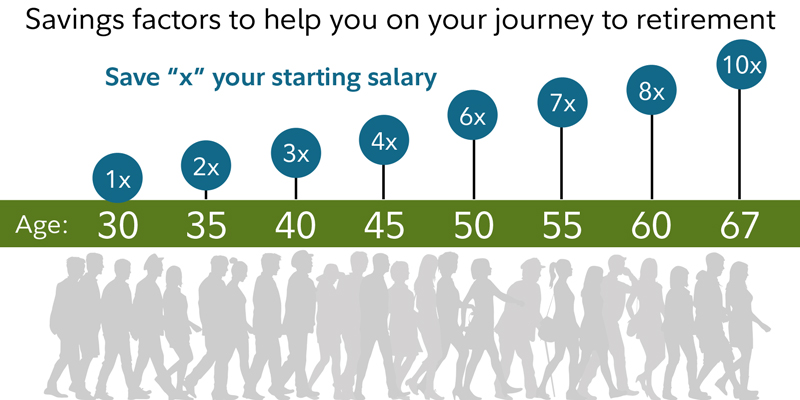
 While there are many variables affecting how much you will need to live on in retirement, no one wants to be caught short. You can borrow money for college but not for retirement. (aside from the option to take a reverse mortgage against your house). Fidelity investments provides some aspirational guidelines to help. 

"Our savings factors are based on the assumption that a person saves 15% of their income annually beginning at age 25 (which includes any employer match), invests more than 50% on average of their savings in stocks over their lifetime, retires at age 67, and plans to maintain their preretirement lifestyle in retirement."

By age 30 you should have accumulated one time your salary; If you're not there yet it may be time to boost your savings. And when I refer to "saving" for retirement I really mean investing.  

Details at: https://www.fidelity.com/viewpoints/retirement/how-much-do-i-need-to-retire


Savings factors to help you on your journey to retirement.  By age 30, have 1x your salary, age 50, 4x and age 60, 8x.

January 17, 2023

Mutual Funds That Consistently Beat the Market? Not One of 2,132

No actively managed stock or bond funds outperformed the market regularly over the last five years. Index funds have generally been better.

Mutual Funds, Funds, Growth, Equity

Writing for The New York Times, Jeff Sommer, explained the results of a recent study of actively managed mutual funds conducted by S&P Dow Jones Indices that concluded "not a single mutual fund — not one — managed to beat its benchmark in either the U.S. stock or bond markets regularly and convincingly over the last five years."
 
"These findings support practical advice that has been the academic consensus for decades. Forget about trying to beat the odds and outsmarting everybody else. Instead, use low-cost stock and bond index funds that mirror the overall market, and keep them for decades." 

In summary, "most actively managed mutual funds do worse than their benchmark index, both over the long run and in the vast majority of calendar years, in the United States and elsewhere around the globe."

Bottom line: Invest in low-cost index funds and Exchange Traded Funds (ETFs).

December 27, 2022

How did stocks perform in 2022?

 Overall, the S&P 500 fell by 19 percent in 2022.

It will probably be one of the 10 worst performing years for the stock index in at least 90 years.

But keep in mind that you probably started investing in stocks well before January 2022. Look at your returns over the long run before panicking.

Because a major stock index is down almost 20% now is a great time to invest for long term goals like retirement. We've all heard the advice "buy low, sell high." Now is a chance to buy when prices are low (relative to the recent past). 

Rather than trying to time the market, set up a regular automatic monthly deposit into your investment and retirement accounts. No one can consistently time the market by guessing exactly when to buy and sell.

This is what we mean when we say stocks are "risky." Actually it's more accurate to say that stock prices can be very volatile. That's why you don't want your emergency reserve funds, or money you expect to need in the next 3-5 years, held in stocks.

I bonds, U.S. Government inflation-adjusted bonds are a great place for your emergency savings, vehicle replacement fund, and other short to medium range goals. 

Just be glad you didn't buy Tesla stock at its peak in November 2021. The stock has lost 70% of its value since then. Another good reason to have a widely diversified investment portfolio. Don't put all your eggs, or even most of them, in one basket. 

The S&P 500 is up 19 percent since 2020!

 If you want to feel better about your investments, you’ll need to go back to the start of 2020. Stocks have rebounded considerably from the brutal bear market at the start of the pandemic.

Graph, Trading, Stock Market, Chart


November 8, 2022

50 Years Later, Burton Malkiel Hasn’t Changed His Views on Indexing

 Burton Malkiel, the author of the classic book A Random Walk Down Wall Street still believes that individual investors can't "beat" the stock market. 

Writing for The Wall Street Journal, Daniel Akst:

'FIFTY years ago this January, an economist named Burton Malkiel published a book calling for an innovation on behalf of the small investor. “What we need,” he wrote, “is a no-load, minimum-management-fee mutual fund that simply buys the hundreds of stocks making up the broad stock-market averages and does no trading from security to security in an attempt to catch the winners.”'

"Dr. Malkiel, 90 years old, still says index investing beats other approaches, and he has half a century of additional data to bolster his case, which he does in a 50th anniversary edition of the book to be published in January. By now an investing classic, “A Random Walk Down Wall Street” has been updated to cover the many financial innovations (from exchange-traded funds to Ethereum) since it was first published. The book retains its author’s trademark blend of erudition and wit—and his insistence that markets really are efficient." 

DR. MALKIEL:  "Each year about two-thirds of active managers underperform the index, and those who outperform in one year are not the same as those who outperform in the next. S&P does something called Spiva, in which they compare the S&P indexes with active managers. And what it shows is that over a 10-year period, roughly 90% of domestic stock funds, for example, are outperformed by the index." (S&P: Standard and Poor's)

WSJ: You advocate indexing, dollar-cost averaging and diversification, and you make mincemeat of such practices as technical analysis, ESG and “smart beta.” You see cryptocurrencies as too risky. 


September 22, 2022

Tiresome Debates about the 4% "rule", Claiming Social Security, and investing vs. paying down debt

 Jonathan Clements, author of the Humble Dollar Blog https://humbledollar.com/ and former Wall Street Journal financial columnist, is one of the most sensible financial experts I've encountered in a 40+ year career of teaching personal finance. Check out his blog.

Rather than me summarizing his main points, read the financial journalists column "Tiresome Debates" about:

1. Should you use the 4% withdrawal rate?

2. Should you take Social Security early and invest the money?

3. Should you use your spare cash to invest or pay down debt? 

Check it out: https://humbledollar.com/2022/09/tiresome-debates/?utm_source=mailpoet&utm_medium=email&utm_campaign=another-ses-test_7 

Explore the Humble Dollar blog for a full financial education:  https://humbledollar.com/

Free Piggy Bank Pig photo and picture 

June 29, 2021

How much to invest to have $1 million by retirement

Start early to attain your goal.

Starting at age 20:
  • Assuming a 6% return, compounded monthly, you should aim to invest $364 a month toward retirement to reach $1 million in savings by age 65.
Starting at age 30:
  • Assuming a 6% return, compounded monthly, you should aim to invest $704 a month toward retirement to reach $1 million in savings by age 65.
Starting at age 40:
  • Assuming a 6% return, compounded monthly, you should aim to invest $1,444 a month toward retirement to reach $1 million in savings by age 65.
Starting at age 50:
  • Assuming a 6% return, compounded monthly, you should aim to invest $3,439 a month toward retirement to reach $1 million in savings by age 65.

    How to retire a millionaire

Invest wisely. Check out other blog posts on index investing and investing.

April 14, 2021

Portfolio Diversification Still Works!

 When was the last time you examined your portfolio allocation? If it's been more than a year, the rising stock market may have up-ended your original asset allocation decision.

Never really decided on an asset allocation? Oh my! Now is the time. 

You don't have any control over the investment markets. You can't control the returns your portfolio earns... but you CAN control 

  • How much you invest
  • Your asset allocation (% allocated to stocks vs. bonds, domestic vs. international, etc. and
  • How much you pay to invest

"Diversification has often been called the only free lunch in investing. As Harry Markowitz first established in his landmark research in 1952, a portfolio’s risk level isn’t just the sum of its individual components but also depends on correlation, or how the holdings interact with each other. Correlation is a statistical measure that ranges from 1 to negative 1 and captures how two securities move in relation to each other (although it only captures the direction, not the magnitude, of those movements)."

"Combining asset classes with correlations below 1.0 reduces the portfolio’s overall risk profile. It's one of the few cases where the whole can be more than the sum of the parts; a well-constructed portfolio can have better risk-adjusted returns than its component parts alone."

"While diversification doesn't work with every asset class in every market, it's still an important tool for improving risk-adjusted returns over the long haul." 

December 28, 2020

Robinhood investing anyone?

Robinhood is an investing platform geared to millennials to make investing look so easy, fun, and sexy... The New York Times reports: "the company has also faced intense scrutiny for its practices." 

"The app has become a favorite of young and inexperienced investors, enticed by no-fee trading, offers of free stocks and an engaging user interface that uses what a New York Times report in July described as the 'Silicon Valley playbook of behavioral nudges and push notifications.'" i.e., you are being manipulated.

 "Last week, the Securities and Exchange Commission charged the company with “misleading customers about revenue sources,” citing “repeated misstatements that failed to disclose the firm’s receipt of payments from trading firms for routing customer orders to them.” Robinhood agreed to pay a $65 million fine. And on Wednesday, Bloomberg News reported that a complaint filed in San Francisco against Robinhood Financial could become a class-action lawsuit."

Source: Robinhood Recaps From a Volatile Year... And you thought your Spotify Wrapped was a bummer.

by Ezra Marcus

October 9, 2020

The least dirty shirt in the laundry: Negative bond yields

 Well, we aren't there yet (negative interest rates) but anyone with a savings account or looking a bond yields lately (or listening to Federal Reserve Bank Chair Jerome Powell) knows that rates are falling fast. 

Many European countries are issuing bonds with NEGATIVE interest rates, meaning that the investor pays the bond issuer a fee to keep their money safe. It's a strange concept when we are used to getting paid by the issuer for the use of our money. 

Why would anyone pay someone to hold their money rather than put it under the proverbial mattress? Why get back at some date in the future less than you invested?

There are $16 trillion of bonds world-wide paying negative interest rates!

Simon Constable, writing for The Wall Street Journal (10/5/20) explains 5 reasons:

1. The bond offers security (at a cost). Think of the negative yield as the storage fee, the cost of security that you will get your money back (less a fee) in the future. Some U.K. banks already are charging savings-deposit customers a negative yield.

2. The chance of a quick trading profit. traders are willing to accept a negative yield if they expect rates to dive lower in the future. they could profit by selling the initial bond at a premium. 

3. When expected currency moves will likely offset the negative yields. This applies to international investors. However, "forecasting future currency movements is notoriously tricky." Not for the faint of heart.

4. When the bond is still safe, relatively speaking. "During the 2008-2009 financial crisis, investors often described the U.S. as the least dirty shirt in the laundry basket, meaning that while the U.S. wasn't in great shape, other countries were in worse condition." The same concept applies today with regard to negative interest rates. What options do you have? Lots of money is flowing into U.S. stocks because bond yields are so low, which explains why the stock markets seem to be ignoring the world-wide coronavirus pandemic. 

5. Purchasing power is maintained. The main reason investors would invest in negative yields is during times of deflation (a sustained drop in prices of goods and services). If prices drop faster than the negative yield, one has more purchasing power.  "If your purchasing power grows over the investment period, it doesn't matter how negative the yield is on the bond." 

This article was followed in the WSJ on 10/9/20 with "Savers face limited option" by Julia Carpenter. Interest rates on savings accounts (including online accounts) are plunging with few options. "Looking for more yield, however, often means taking on more risk and sacrificing liquidity." Some options are money market funds (still low yields) and some fixed-income exchange-traded funds offering 1-2%. 

Just more dirty laundry!


June 17, 2020

Risk Less and Prosper: Your Guide to Safer Investing

During the market volatility brought on by the Coronavirus is a great time to read this classic book by Zvi Bodie and Rachelle Taqqu (2011).
A practical guide to getting personal investing right "Somewhere along the way, something has gone very wrong with the way individuals save and invest. Too often, households are drawn in by promotional suggestions masquerading as impartial investment advice. Consumers get saddled with more risk than they realize. Authors Zvi Bodie and Rachelle Taqqu understand the dilemma that today's investors face, and with Risk Less and Prosper they will help you find your financial footing.
Written in an accessible style, this practical guide skillfully explains why personal investing is all about you―your goals, your values and your career path. It shows how to understand investment risk and choose the particular blend of risk and safety that is right for you. And it lays out several simple yet powerful ways for small investors to cast a reliable safety net to achieve their financial goals and truly prosper. Coauthors Bodie and Taqqu challenge the myth that all investments require risk, then highlight some important risks that families often disregard when deciding where to put their money. Later, they connect the dots between investment and investor, showing us all how to grasp our own investment risk profiles and how we may use these insights to make more fitting investment choices.
  • Outlines a straightforward way to invest by aligning your investments with your goals and the risk levels you can bear
  • Provides basic investment abc's for readers who are otherwise literate
  • Lays out a simple, actionable plan for achieving your goals
  • Explains the role of risk-free assets and investment insurance in assuring that you reach your most essential goals
Contrary to popular belief, investing doesn't have to be complicated. You can build wealth without taking great risks. Risk Less and Prosper will show you how to make investment decisions that will make your financial life less stressful and more profitable." (Amazon.com)

The Little Book of Behavioral Investing: How Not to Be Your Own Worst Enemy

I haven't read this yet but it seems like a very timely title and approach during these times of drmatic financial market volatility.
According to the Good reads website the book is :

"A detailed guide to overcoming the most frequently encountered psychological pitfalls of investing Bias, emotion, and overconfidence are just three of the many behavioral traits that can lead investors to lose money or achieve lower returns. Behavioral finance, which recognizes that there is a psychological element to all investor decision-making, can help you overcome this obstacle."

"In The Little Book of Behavioral Investing, expert James Montier takes you through some of the most important behavioral challenges faced by investors. Montier reveals the most common psychological barriers, clearly showing how emotion, overconfidence, and a multitude of other behavioral traits, can affect investment decision-making."

https://www.goodreads.com/book/show/6922765-the-little-book-of-behavioral-investing

June 16, 2020

The "Perfect Storm of Stupid" and other Coronavirus stock market theories

Why has the stock market gone up dramatically (after initial plunge) during a pandemic?
Some ideas... courtesy of Planet Money

The “Perfect Storm of Stupid” Theory

Basically, Americans are super bored. They’re at home. Sports are canceled. The kids are screaming. The casinos are closed. And around 800,000 additional people have decided to plop down money on the biggest roulette table of them all: the stock market. Bloomberg columnist Matt Levine calls it “the boredom markets hypothesis.” Business Insider columnist Linette Lopez calls it “the perfect storm of stupid.” Shiller didn’t shoot this theory down. “This is just speculation," Shiller says, "but it seems like people want to do something.”

Some other theories:
The Corporate-America-Is-Immune-From-Pain Theory

"The stock market represents only a fraction of the economy: publicly traded corporations. While restaurants, mom-and-pop shops, and other small businesses have clearly been hammered, the majority of them are not listed on the stock market."


The Fed Theory

"This theory says the Fed is using its unlimited money-printing machine to single-handedly prop up the stock market."
The FOMO Theory
The fear of missing out is a prominent motivator for investors

The TINA Theory 

Then there is the “There Is No Alternative” theory, aka TINA. It basically says that with interest rates so low, stocks are the only money-making game in town. 

The Efficient Market Theory

"It paints the stock market as a supermachine for information processing, where knowledge about the happenings of the world are all aggregated by brainiac investors, who rationally buy and sell stocks based on the best information of their future performance. The theory basically says stock prices are always right. Under this theory, the rally of the stock market over the last few months reflected rational investors seeing signs that the pandemic wouldn’t be too bad and that the recovery was going to be really good."

Source: https://www.npr.org/sections/money/2020/06/16/877410547/what-is-the-stock-market-trying-to-tell-us?utm_source=npr_newsletter&utm_medium=email&utm_content=20200616&utm_term=4623696&utm_campaign=money&utm_id=44131415&orgid=
 

April 25, 2020

How to survive a bear market

https://www.pexels.com/photo/animal-animal-photography-bear-black-and-white-598966/
"Investors can survive a bear market the same way hikers survive an encounter with a bear: Remain calm and don't make sudden moves" as Wall Street Journal writer Jason Zweig advised on April 4-5, 2020.
See: Staying safe around bears: https://www.nps.gov/subjects/bears/safety.htm

Consider your entire portfolio, including your human capital and Social Security benefits.
as Zweig explains: "your expected social Security payments are like a giant phantom annuity."  Any defined benefit pension plan is a similar (but not inflation-adjusted) annuity. Thus, your total portfolio is bigger than your 401(k) statement and less exposed to the stock market.

Don't know what an annuity is? Search this blog for the answers. 

Now may be a good time to consider converting  traditonal IRA to a Roth IRA, paying taxes now for tax-free income in the future.

How I learned to stop worrying and love the bear market

Spencer Jakab, writing for The Wall Street Journal (3/28-29/20) explains:

A surprising share of a new bull market’s returns pile up in its very early stages, when the average investor is at their most fearful 

https://www.pexels.com/photo/woman-carrying-bear-plush-toy-inside-store-1860160/"Investor psychology in a major bear market is a mirror image of what it was the past few years: The more false alarms there were on the way up, the likelier investors were to embrace risk, viewing dips as buying opportunities. On the way down, so-called suckers’ rallies... get our hopes up and then crush them."

"A surprising share of a new bull market’s returns pile up in its very early stages when people are most fearful. Take the one that ended last month. Putting $100,000 into an S&P 500 index fund on the day the bull began on March 9, 2009 and selling at last month’s peak would have seen that turn into $630,000 including dividends. Waiting just three months to make sure it wasn’t yet another head fake would have earned you only $450,000."

"If you wait for happy headlines or hopeful government statistics for a clue for when to pounce, you’ll be too late. Stocks typically rally before a recession is over." 

"Making lemonade out of the market’s lemons sounds tempting, but it isn’t easy. The old saw goes that the stock market is the only one where people run away when there’s a sale. Beforehand they crowd in when the wares are most expensive because they see everyone else getting rich. For example, in the 10 months leading up to the last market peak in October 2007, a net $84 billion flowed into equity mutual funds according to the Investment Company Institute. By contrast, a net $233 billion flowed out from June 2008 through March 2009, the heart of the bear market when stocks became screaming bargains."

"If the last month truly convinced you that you had too much money in stocks to sleep well at night then take your lumps and dial back your risk permanently. But if you’re merely waiting for a sign that it’s safe to buy again then just hold your nose, increase your allocation to equities, and learn to love bear markets."

So you think you're going to time the market and jump in when things look good

https://www.pexels.com/photo/black-and-white-dartboard-1552617/
Forget about it! The stock market lurches up and down in dramatic gains and losses with no warning!
No bell rings at the bottom of the market signaling it's time to buy!
Some recent examples, among the gut wrenching downward drops:
March 27, 2020 the Dow Jones Industrial Average jumped 12.8%! in one day!
April 9, 2020: the DJIA leaped 12.7%.
This was the index's best rally since 1974 (before many investors were born).
there were only 7 days in all of the stock market history that the market rose at a faster rate.
The stock market (whether measured by the DJIA or the broader S&P 500 largest companies) can swing wildly in one day. It does not increase or decrease gradually. Due to computerized trading, it's NOT individual investors or individual professionals deciding to buy or sell on any given day. So much of trading is based on algorithms that automatically buy and sell based on computer models.

So... what does this mean for individual investors:
Don't have money in the stock market that you will need in the next 5 years.
Have a serious talk with yourself about your risk tolerance, time horizon, investment goals, and, especially for retirement investors, your capacity for risk.
Risk capacity is different from risk tolerance. How secure is your job? does your spouse/partner have a secure income? are you single? Do you have a mortgage? How much debt do you owe?
Besides, plenty of evidence has demonstrated that investor risk tolerance is NOT stable but increases with rising (bull) markets and plummets with falling (bear) markets. Those risk tolerance quizzes that investment pros require you to fill out... not worth the paper they are printed on.
What did you do with your investments during the financial crisis of 2008-09? 
Don't make short sighted decisions based on the hype of today's stock market report.

Remember that investment losses inflict twice as much pain as similar dollar amounts of gain provide pleasure. Losses hurt twice as much as gains feel good, even when the potential loss is relatively small and doesn't pose much risk.  This is the concept of Loss Aversion. Loss aversion explains why too many investors sell at the bottom of the market and wait to resume investing until prices have risen, often above what they sold their investments for in order to avoid a loss. They locked in a loss by not understanding their own risk tolerance and investment psychology.
A market decline is an opportunity to buy stocks when they are on sale. Why is it that individual investors love to buy when stocks are overpriced? Buy a case load when the product is on sale.

Instead of trying to time the market, invest a set amount each month to add to your portfolio, regardless of the price. Practice dollar cost averaging. 

Work with a trusted financial adviser who is a fiduciary and committed to putting the client's needs above their own.
Determine a realistic asset allocation for the long run and stay the course. 
P.S. Good luck with that!

A Simple Global Market Portfolio

A Simple Global Market Portfolio consists of "all stocks, bonds and other assets that are readily tradeable. This is the mix of investments that’s owned by all investors worldwide and reflects our collective judgment of what different securities are worth" writes Jonathan Clements in the Humble Dollar weekly email. Sign up at https://humbledollar.com

https://www.pexels.com/photo/achievement-bars-close-up-commerce-386318/You can build this portfolio with "five exchange-traded index funds: 40% Vanguard Total World Stock ETF (symbol: VT), 21% Vanguard Total Bond Market ETF (BND), 33% Vanguard Total International Bond ETF (BNDX), 5% iShares Global REIT ETF (REET) and 1% Invesco DB Commodity Index Tracking Fund (DBC). The Vanguard Total World Stock ETF currently has 57% in U.S. stocks and 43% in international markets."

According to Clements, "it’s the ultimate “neutral” investment mix and hence should be our starting point in designing a portfolio." Stray from this basic mix for  the following reasons: "time horizon, job security and stomach for market turbulence."

April 17, 2020

Why is US stock market doing OK while the economy is tanking?

https://www.pexels.com/photo/black-and-white-business-chart-computer-241544/
Investors worldwide are looking past economic data and coronavirus statistics to seek haven in US equities. Emerging-market equities are the cheapest against the S&P 500 in 12 years, while the MSCI USA Index is near a 20-year high against the rest of the world.
Full Story: Bloomberg (tiered subscription model) (4/16) 

April 9, 2020

Investing Facts of Life


Facts of Life
Jonathan Clements  |  April 4, 2020
THE PLOT, THE SCRIPT and the characters may have changed. But we’ve seen this movie before.
The current stock market swoon strikes many folks as unprecedented: It’s the frantic financial sideshow to a devastating global tragedy—one that’s seen 1.1 million people fall ill and 60,000 die, with every expectation that the numbers will be many multiples worse before the COVID-19 pandemic is over.
Yet, on closer inspection, 2020’s bear market doesn’t seem so different from earlier market declines. Once again, we’re being reminded of some crucial facts of financial life. Here are seven of them:
1. Our risk tolerance isn’t stable.
2. Losses wreak havoc with compounding.
3. In Treasurys, we should trust.
4. Bonds are less risky than stocks—except when we go to trade.
5. If we wait for stocks to get cheap before buying, we’ll likely wait an awfully long time.
6. To earn handsome long-run returns, we must run the risk of severe short-term losses—and those losses occur with brutal regularity.
7. If an investment offers high expected returns, there must be high risk—even if we can’t figure out what that risk is.

Read Clements full comments on his blog which I highly recommend. 

March 28, 2020

So you think you're going to jump back in the market after it bottoms out

"The problem with “going to cash” in a crash is that you lock in your losses. Maybe your plan is to jump right back in after the market bottoms? Good luck with that. When markets do turn back up, they do so quickly.  As financial planner Kristin McKenna explains here, six of the 10 best daily gains in the S&P 500 between January 2000 and December 2019 occurred within two weeks of the worst 10 days. Had you missed all of those 10 best days, your average annualized total return on the S&P 500 for those two decades would have been 2.44% compared to 6.06% had you stayed fully invested and ridden the roller coaster down and back up."

https://www.forbes.com/sites/janetnovack/2020/03/16/8-ways-coronavirus-will-drastically-alter-boomer-retirements/amp/
Financial Planning for Women does not sell, rent, loan, lease or otherwise provide any personal information collected at our site to any third parties.