Showing posts with label women finances. Show all posts

March 2, 2024

Women’s Guide to Making Financial Moves After College

 "Graduating from college is an exciting time, full of potential to begin investing in your financial and personal goals. But life after college brings its own challenges for women — especially if you’re carrying the burden of student debt, which many are. It’s helpful to arm yourself with solid practices as you embark on the next phase of your life. The earlier you’re able to start saving, build credit and knock down debt, the better your financial future will be." Writing for Money Geek,

Among the topics she addresses in the article linked below are:

Common Financial Challenges Women College Grads Experience

Tackling Your Student Loan and Other Debts

Boosting Your Confidence in the Workplace

Establishing a Strong Financial Foundation

Expert Insight on Women Graduates’ Finances- this section includes advice from 6 women professionals. Check it out!

Read the full article to get the details: https://www.moneygeek.com/financial-planning/womens-finance-after-college

June 29, 2021

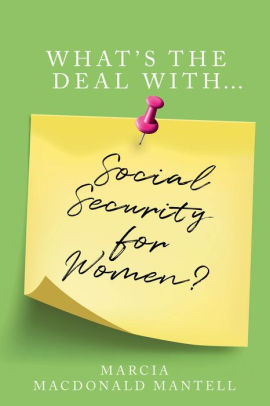
What's the Deal with Social Security for Women?

 What's the Deal with Social Security for Women? is a new book by Marcia Mantell.

What's the Deal with Social Security for Women 

The following is quoted from: https://www.barnesandnoble.com/w/whats-the-deal-with-social-security-for-women-marcia-mantell/1133342938

"As a woman nearing retirement, you may be delightfully surprised to get your own Social Security check. But you probably have questions. Questions such as:

  • How much money will I actually get from Social Security?
  • How soon can I retire and start collecting my Social Security?
  • What are my options for claiming?
  • Do I really get benefits on my spouse or ex-spouse?

Drawing on the author's expertise and sharing the personal stories of real women, What’s The Deal With Social Security for Women opens the door on how Social Security works regardless of your life's journey. It's for you if you’re married, divorced, widowed, or single and will take some of the mystery out of this complex yet critical income source. Read this book discover how important it is to:

  • Make smart decisions about when to claim Social Security
  • Receive more monthly income by claiming after age 62
  • Learn the facts about Social Security's future
  • Balance time and money when deciding when to retire"


March 17, 2021

Understanding the women’s wealth gap webinar March 31

 The consumer Financial Protection Bureau presents:

Understanding the women’s wealth gap

Thursday, March 31, 2021, 2-3:30 p.m. ET

Join us for facts about the women’s wealth gap and the unique challenges many women encounter on their journey to financial well-being. The presentation addresses the impact of COVID-19 on women, the challenges women face in retirement, and how intimate partner violence can impact women’s pursuit of financial well-being.

According to the five principles of effective financial education, programs can be more effective when they matched to people’s specific circumstances, challenges, and goals. This webinar can help you improve your effectiveness through a better understanding of the people you serve.

Audio and presentation: https://cfpbgov.webex.com/cfpbgov/onstage/g.php?MTID=ecb0a2d5242e62395cda06f7d5217f67e

Event number: 199 468 0363

Audio only:
Dial-in:   +14043971590
Access code:   199 468 0363
Event Password: tvD2B6JKav3@ (88322655 from phones)

June 21, 2019

Married women more at risk in retirement than singles


Women in their 50s who are married have a higher retirement risk than those who are single, widowed or divorced, according to a study that uses information from the National Retirement Risk Index. Factors include married couples' lack of enough savings for two people in 401(k) plans and the way Social Security benefits are calculated, writes Alicia Munnell, director of the Center for Retirement Research at Boston College.

April 17, 2018

Too many women still let husbands make important financial decisions

Fully 56% of married women still leave major investing and financial planning decisions to their husband, according  “Own Your Worth,” a report from UBS Global Wealth Management.
Why is this a concern?
The divorce rate for ages 50+ has doubled since 1990
Women live about 5 years longer than men (and often marry older men)
Women are much more likely than men to experience poverty in old age or a steep reduction in their level of living after death of spouse or divorce
You'd think the situation would be better for young er women but UBS reports that 61% of millennial women let their husbands make the couple's investment decisions!
Women who fail to take responsibility for their long term financial future by abdicating decisions to their husbands often experience a rude shock after divorce or death of their spouse.
Read: Rise of ‘Gray’ Divorce Forces Financial Reckoning After 50 by Suzanne Wooley at;
https://www.bloomberg.com/news/articles/2018-04-13/rise-of-gray-divorce-forces-financial-reckoning-after-50

October 1, 2017

How women undermine their retirement security

"While women still face a gender pay gap, their inclination to put family expenses first and their reluctance to discuss financial matters also hurt retirement savings. The Women's Institute for a Secure Retirement symposium explored possible solutions, including forming financial book clubs and taking advantage of employers' automatic enrollment or automatic escalation for retirement savings." http://www.nextavenue.org/wisest-retirement-solutions-women/
Author Kerry Hannon writes: "From my research, I’ve found that the root of the money quandary many women face is their own attitude. And that’s manageable. You can control how you approach your finances. You can stop the negative mental chatter. You can put an end to procrastinating. You can choose to make understanding your own financial decisions a priority. And you need to." Amen! My research also found that women put themselves last, often supporting adult children who need to be cut off the parental gravy train.

August 21, 2017

Women spend less than half of adult life in marriage- implications for retirement

A study by the Center for Retirement Research at Boston College found that the average US woman now will spend less than half of her adult life as part of a married couple. This "has significant implications for financial planning," the study's authors note. (8/21/17 Retirement Security Smartbrief).

Do Women Still Spend Most of Their Lives Married?

by,and

IB#17-14

The brief’s key findings are:
  • Traditionally, women spent their adult lives married, so it made more sense to study households rather than women separately.
  • The question is whether today’s women are spending fewer years married.
  • The analysis looks at four birth cohorts, ranging from the Depression Era to Mid Baby Boomers.
  • No matter how you define the age span, the percentage of years spent married has dropped from about 70 percent to 50 percent.
  • The reasons are three-fold: 1) fewer women get married; 2) when they do marry, they get married later; and 3) more women end up divorced.
  • Thus, looking at women’s finances separately from men is increasingly necessary for a full assessment of their retirement security.
http://crr.bc.edu/briefs/do-women-still-spend-most-of-their-lives-married/ 
Women need to invest for retirement security beginning with their first job and not depend on a man for financial security in later life. 

May 6, 2016

The Huge Retirement Penalty for Being a Mom

To reinforce my earlier post about giving mom an Individual Retirement Account rather than flowers or brunch for Mother's Day read on...
"As Mother’s Day approaches, families are busy buying flowers or booking a brunch at a favorite restaurant. Sounds great, but you may want to check on Mom’s retirement plan."
1. Moms generally earn less… 
2. …so they save less for retirement…
3. …and receive lower Social Security benefits.
4. Yet they have longer retirements to finance…
5. …which adds up to higher odds of poverty in retirement.    
Read the details by Penelope Wang at: http://time.com/money/4318170/retirement-penalty-mother/
Then search for "IRAs" on this blog for how to arrange an individual retirement account for mom. Adult children might want to contemplate the impact on their lives when mom is old and living on only Social Security.

June 10, 2015

Single female boomers are happier, healthier and more confident

It's great to read some good news about single women.

"Over half of unmarried female baby boomers plan to stick with their job for at least five years, according to a survey by Del Webb. "We've seen that single female boomers are happier, healthier and more confident than ever, and our survey results show that those who are still working aren't rushing to retire," Division President Lindy Oliva said." Read details at: http://www.thinkadvisor.com/2015/06/09/forget-retirement-older-single-women-love-their-jo

December 28, 2014

Time for single, divorced, & widowed boomer women to invest for retirement

In "6 ways boomer women can get retirement savings on track" Melody Juge gives advice to single, divorced or widowed boomer women. She provides excellent advice at http://www.marketwatch.com/story/6-ways-boomer-women-can-get-retirement-savings-on-track-2014-10-22?page=1. My students discovered you can start an IRA at Schwab for only $100. With the dramatic drop in the price of gas, you can find the money to get started in less than a month.

September 10, 2014

Women & Investment Risk

"Why (retired) women need to take more investment risk." Although focusing on retired women, Eleanor Blayney's advice to women on the need to take a modest amount of investment risk applies to women of all ages. You could never keep up with inflation by putting all your money in federally insured savings vehicles. Blayney is consumer advocate for the Certified Financial Planner Board of Standards. Read her short, succinct article at: http://blogs.wsj.com/experts/2014/09/09/why-retired-women-need-to-take-more-investment-risks/

August 6, 2014

Warren Buffett Invests Like a Girl


“Too much testosterone… can encourage too much risk taking.… The way women tend to approach investing is healthier and calmer, and it’s the way we should all approach investing,” according to author LouAnn Lofton, author of Warren Buffett Invests Like a Girl--And Why You Should, Too.
·  Women spend more time researching their investment choices and tend to take less risk than men do. This prevents them from chasing "hot" tips and trading on whims. Women are also more likely to seek out information that challenges their assumptions.
·  One study found that men trade 45 percent more often than women do, and although men are more confident investors, they are also more susceptible to becoming overconfident. By trading more often—and without enough research—men reduce their net returns and increase transaction costs and capital gains taxes.
·  Women aren't as susceptible to peer pressure as men are, which results in a more levelheaded, patient approach to investing.
·  Women have less testosterone than men do (not a surprise, we know). New and continually unfolding science points to the possibility that testosterone is responsible for herdlike risk-taking behavior from men in the financial markets.

January 27, 2014

Romance novel touts bliss of financial independence

"Personal-finance tomes aren't usually bodice rippers with breathless sentences like: "She wanted him and couldn't wait to have him, was totally addicted to his touch and couldn't resist him."
But Boca Raton financial planner Kathleen Grace, 46, wanted to explore women's emotions about money and love – and how those feelings can interfere with managing money.
So Grace, who co-founded Excelsior Capital Advisors, hired a romance writer to help her create a modern fairy tale of Cinderella — "Cindi," a fashion designer in South Florida who is afraid to talk about money in fear of displeasing her current heartthrob of a husband."
"Prince Not So Charming: A Romantic Tale of Financial Independence," which is sold on Amazon for $12.06. Read more about the "bodice ripper" from
http://www.sun-sentinel.com/fl-romantic-cinderella-financial-independence-20140125,0,1933919.story

May 8, 2013

Project Renewment: a Retirement Model for Career Women

"For the first time in history, career women—women who have worked outside the home for most of their lives—are retiring. These women are highly skilled, educated and successful. They have achieved visibility, status and influence. And, because they are the first large group of American women to define themselves by their work, they have few, if any, models for retirement." 
"Bratter (a marriage and family therapist) and Dennis (an expert on the issues of aging, employment, and retirement) wrote a book, Project Renewment: The First Retirement Model for Career Women, to communicate what they had learned and to help other career women make their own successful “renewment” transitions."
“Renewment” is a term that Bratter and Dennis created as an alternative to “retirement”—a word that is often associated with negative stereotypes and clichés. “In contrast,” they write, “renewment is positive, suggesting rebirth, choices, vitality, opportunity and personal growth.”  They further explained, “It implies that decisions about the next chapter of life can be intentional rather than defined by the needs and expectations of others.” "Their book also includes guidelines for creating and sustaining project renewment discussion groups." For more information, visit www.ProjectRenewment.com.

April 18, 2013

Women “Reactive,” Not Planning Finances

is the title of the Squared Away blog post about research conducted at Utah State University by graduate student Megan Rowley and professors Jean Lown & Kathy Piercy. 
"What motivates women to get to work on their personal finances?  Change.
Emotions are also important motivators.  But 'the most compelling factor' spurring most of the women interviewed in a focus group to take action was a significant life change, Utah State University researchers write in the Journal of Financial Counseling and Planning.
Since April is financial literacy month, Squared Away is again making an appeal to women, who continue to make strides professionally, yet lag men in understanding how to manage their money." So check out the excellent Squared Away blog produced by the Center for Retirement Research at Boston College. http://squaredawayblog.bc.edu/squared-away/women-reactive-not-planning-finances/ Sign up for regular email updates on their website. The blog provides high quality, research-based personal finance and retirement information.

December 10, 2012

More Than 80 Percent of Centenarians are Women!


 “The 2010 Census counted 53,364 people age 100 and older in the United States, and they were overwhelmingly female. For every 100 centenarian women, there were only 20.7 centenarian men. The report, Centenarians: 2010, also compares centenarians with other age groups in the older population.”
Are you planning for the possibility of joining this exclusive club?
Financial Planning for Women does not sell, rent, loan, lease or otherwise provide any personal information collected at our site to any third parties.