Showing posts with label investing truths. Show all posts

December 26, 2023

Don't believe any of the investing forecasts

Wall St. Loves to Guess, but Nobody Knows What the Market Will Do in 2024

So-called stock forecasts don’t deserve the name, our columnist says. Wall Street’s track record is horrendous.

who writes Strategies, a weekly New York Times column on markets, finance and the economy.

"Wall Street strategists are issuing forecasts for the performance of the stock market in 2024.

Pay them no mind.

The predictions are usually wrong, and when they’re right it’s only by accident."

These forecasts get a tremendous amount of media coverage but aren't worth the paper/pixels they are written on.

Sommer advises: "If you find them entertaining or otherwise illuminating — wonderful. Enjoy them."

"But at all costs, don’t take them at face value because there is no evidence that anyone can predict the market’s movements reliably, and a great deal of evidence that buying and selling stock on the basis of your views about the market’s impending movements is a fool’s game."

It is amazing how much money these investment analysts and gurus are paid to speculate about the future. 

In 2019 who would have predicted Covid 19 and the way it affected economies throughout the world for the next three years?

In 2022, not even the best Pentagon and CIA analysts predicted that Russia would invade Ukraine and disrupt grain markets and raise food prices throughout the world in addition to many other economic impacts. 

Israel, with the best spies, analysts and undercover agents around the world, was taken by surprise by the Hamas attack on October 7, 2023.

Even setting aside these earth shaking events, it is literally impossible to predict the direction of investment markets. Reams of academic research papers have explored this topic and all agree that no one can reliably predict short term investment markets. 

You can't control markets so stick to what you can control: your asset allocation and how much you pay for investing. Choose ultra low cost index mutual funds for your long term goals.


December 11, 2020

Lawmakers with stock holdings vote in ways that juice their portfolios

"Amid calls for stricter regulation of congressional stock ownership, researchers find that financial self-interest outweighs party, ideology and other factors in policy decisions" according to Washington Post reporter Christopher Ingraham
December 20, 2020. 

"A series of well-timed stock trades early in the pandemic brought Justice Department scrutiny on at least five U.S. senators this year over potential insider trading, including Georgia Republicans Kelly Loeffler and David Perdue. Though the inquiries were dropped, both lawmakers have taken heat on the issue as their respective campaigns head into a January runoff election that will determine partisan control of the Senate."

"New research from political scientists Jordan Carr Peterson and Christian Grose underscores why tighter regulations might be necessary. They found that members of Congress who own stock tend to vote in ways that benefit their portfolios and that these decisions can’t be explained away by other factors, such as ideology or constituent interests."

"This behavior, it’s worth noting, is perfectly legal. While the 2012 Stock Act prohibits members of Congress from insider trading, there is nothing to prevent them from casting votes that increase the value of their assets based on public information."

So if you think your representative is voting to represent your interests as a constituent, time to reassess.

October 27, 2019

Wall Street Brokers missed the memo on Index Funds

"In recent years, investors have been flocking to low-cost index funds, driven by their long-term record of outperforming higher cost actively managed funds" writes Randall Smith in The Wall Street Journal (10/7/19). However, clients of Wall Street brokers have just 29% of assets in passive index funds according to a report by Cerulli Associates. The situation is even worse for clients of regional and independent firms with only 20-22% of assets invested in index funds. Who is getting rich? Certainly not the client who is paying high fees for funds that under perform their indexes. The benefits of index investing has been a major theme of this blog. Check out other posts that may convince you that your charming, persuasive broker may not have your best interests in mind.

May 27, 2019

Investing $5,000 a year results in $1.2 million in 40 years so start now!

Wait... $5,000 x 40  $200,000. How did you get $1.2 million? The extra $1million is due to compounding.
Writing for MarketWatch, Mitch Tuchman explains compound interest.

“Shark Tank” star Kevin O’Leary has some simple advice for anyone who finds investing scary: Just do it. Now.
“When you’re 21 years old, or 20 or 18 or 19 and you start putting aside 10% of what you make, you’ll [have] over $1 million by the time you’re 65,” O’Leary told CNBC.
“If no one else is going to worry about your retirement, I want you to worry about it.”

https://www.marketwatch.com/story/kevin-oleary-this-easy-math-trick-helps-you-crush-retirement-goals-2019-03-28?mod=cx_picks&cx_navSource=cx_picks&cx_tag=mw&cx_artPos=7#cxrecs_s

Of course, investing never provides a guaranteed annual return but the example should motivate you, whatever your age, to convert your daily impulse spending into future financial security....even if you have less than 40 years until your "financial freedom" goal.

November 27, 2018

Brokers can purge complaints to make themselves look ethical

The Wall Street Journal reports that "thousands of brokers have scrubbed their records clean of complaints by customers and employers, allowing them to hide information from potential investors. "The process, called "expungement" is under the direction of the Financial Industry Regulatory Authority (FINRA), that regulates the industry and is funded by those it regulates. According to an academic research study 70% of brokers who apply to have their misdeeds wiped from the records are granted their request. So don't trust the FINRA "broker check" resource on its website.

January 22, 2017

How long will this bull market in stocks last?

The "bull market for stocks is 94 months old, making it the second-longest in modern history" according to Jason Zweig, writing in The Wall Street Journal, Jan. 21, 2017. In his weekly "Intelligent Investor" column Zweig explains the results of recent research showing that investors are affected by the optimism of other investors, often resulting in poor decisions. Investor optimism indices have increased recently. Zweig explains: "New research shows that the confidence of others can influence your decisions even more than your own experience can. At a time when stocks and bonds alike are expensive, investors need to be even more vigilant than usual against the risk of getting stampeded by other people’s emotions." (emphasis added). Now seems like a good time to reblance one's portfolio and if you need cash, do like I've been doing, sell your winners and lock in those gains. This bull market will NOT last forever.
"Confidence is contagious. But acting on it can be dangerous." (Zweig)

October 31, 2016

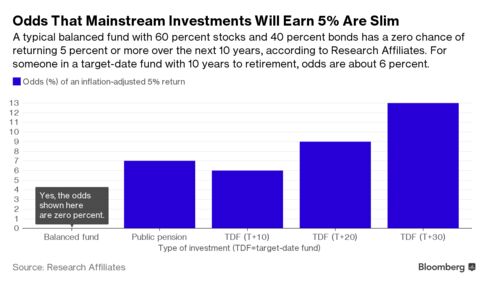
Expect lower portfolio returns in the future


"There is a 0% chance of getting a 5% annualized return over the next 10 years in a balanced fund of 60% stocks and 40% bonds, according to a report from Research Affiliates. Target-date funds have only a slightly better chance, with a target-date fund with 10 years to retirement having only a 6% chance of achieving 5% a year, the report found."  Suzanne Woolley summarizes the study results in

"The Next 10 Years Will Be Ugly for Your 401(k)" available at: http://www.bloomberg.com/news/articles/2016-10-26/the-next-10-years-will-be-ugly-for-your-401-k

April 12, 2016

Diversification is the only free lunch


"Consider a portfolio with a mix of stock types, such as smaller companies, international companies, emerging markets, etc. for your equity allocation. Diversification is the only free lunch when it comes to investing. Spreading your bets across many different investments may mean you won’t have top returns in any year but will give you the best chance to have strong returns over the long haul."
Quoted from:What stock-market return should your financial plan assume? By David Blanchett, 3/31/16. David Blanchett is the head of retirement research for Morningstar Investment Management.

http://blogs.wsj.com/experts/2016/03/31/what-stock-market-return-should-your-financial-plan-assume/

October 23, 2014

How to Win the Loser’s Game: Making the case for evidence-based investing


This series of short videos, produced in 2014 in the UK (but virtually all the concepts apply here in the U.S. and Canada), “has been created to provide investors and investing professionals with clear, concise and independent information about investing and, specifically, the benefits of evidence-based (or passive) investing.” http://www.sensibleinvesting.tv/about-us
Based on solid research and including interviews with Nobel Prize winning economists, the videos speak plainly to the average investor. You can forget about making your financial advisor rich; skip the actively managed funds sold by commission-earning salespeople. Watch and apply this information to your own investing: https://www.youtube.com/watch?v=wXgzFDgdxJk
Financial Planning for Women does not sell, rent, loan, lease or otherwise provide any personal information collected at our site to any third parties.