Confused
as to whether annuities fit into your retirement plans? Are you trying
to decide on lump sum payout or what to do with this
money? This is one of the many great financial webinars from UF/IFAS
Extension.
Learn
about different types of annuities and things to consider before
purchasing. Discussion includes types of annuities; fees & charges;
and settlement options.
1:30 to 2:30 PM MDT http://bit.ly/Annuities101

May 14, 2013


Americans don't understand credit scores
"Between
one-quarter and two-fifths of consumers can't answer basic questions
about their credit scores, and many believe that age and marital status
affect their scores, according to a survey
by the Consumer Federation of America and VantageScore Solutions. By
failing to understand credit scores, people "have little incentive to
manage the real things that truly do make a difference, such things as
paying bills on time, keeping credit card balances
low, and not taking out unnecessary loans," said Barrett Burns,
president and CEO of VantageScore." Retirement Security SmartBrief, May 14, 2013. For details: http://www.americanbanker.com/issues/178_92/study-shows-widespread-ignorance-on-credit-scores-1059067-1.html
May 13, 2013
Should Everyone Go To College?
Research published by the Brookings Institution suggests that the return on an investment in college is not always positive. According to researcher Isabel Sawhill, "There is enormous variation in the so-called return to education
depending on factors such as institution attended, field of study,
whether a student graduates, and post-graduation occupation. While the
average return to obtaining a college degree is clearly positive, we
emphasize that it is not universally so. For certain schools, majors,
occupations, and individuals, college may not be a smart investment. By
telling all young people that they should go to college no matter what,
we are actually doing some of them a disservice." With the rising cost of college and high student debt loads, this article is must reading for high school students and their parents:
http://www.brookings.edu/research/papers/2013/05/08-should-everyone-go-to-college-owen-sawhill
http://www.brookings.edu/research/papers/2013/05/08-should-everyone-go-to-college-owen-sawhill
May 8, 2013
Project Renewment: a Retirement Model for Career Women
"For the first time in history, career women—women who have worked
outside the home for most of their lives—are retiring. These women are
highly skilled, educated and successful. They have achieved visibility,
status and influence. And, because they are the first large group of
American women to define themselves by their work, they have few, if
any, models for retirement."
"Bratter (a marriage and family therapist) and Dennis (an expert on the issues of aging, employment, and retirement) wrote a book, Project Renewment: The First Retirement Model for Career Women, to communicate what they had learned and to help other career women make their own successful “renewment” transitions."
"Bratter (a marriage and family therapist) and Dennis (an expert on the issues of aging, employment, and retirement) wrote a book, Project Renewment: The First Retirement Model for Career Women, to communicate what they had learned and to help other career women make their own successful “renewment” transitions."
“Renewment” is a term that Bratter and Dennis created as
an alternative to “retirement”—a word that is often associated with
negative stereotypes and clichés. “In contrast,” they write, “renewment
is positive, suggesting rebirth, choices, vitality, opportunity and
personal growth.” They further explained, “It implies that decisions
about the next chapter of life can be intentional rather than defined by
the needs and expectations of others.” "Their book also includes guidelines for creating and sustaining project
renewment discussion groups." For more information, visit www.ProjectRenewment.com.
Translating Savings to Retirement Income
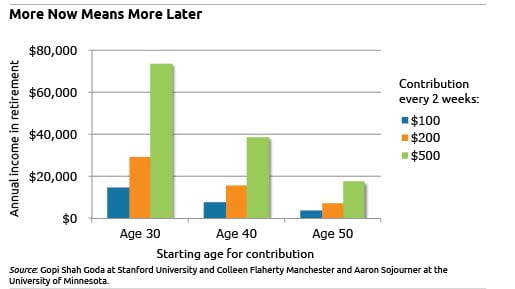
"Determining how much money one will need in retirement is a mathematically and psychologically daunting task for many Americans. But new research has landed on a deceptively simple strategy for prodding workers to save.
Employees in an experiment at the University of Minnesota saved more for retirement after researchers provided them with a personalized chart with information similar to that shown below. Each employee’s chart translated a $100, $200, or $500 contribution, made every other week, into the amount of income each of these contributions would generate annually once they retired. If they saved more, they could see that it translated to more retirement income." Learn more about this concept at the Center for Retirement Research's "Squared Away Blog" and consider what it means to your own life: http://squaredawayblog.bc.edu/squared-away/translating-savings-to-retirement-income/
Payday Loans Cost the Economy
I expect most readers of
this blog know that payday loans are toxic for consumers; unfortunately our
legislators are more heavily influenced by industry lobbyists than research. Perhaps
this data on the negative impact on the economy will hold some weight. “Payday
loans cost the U.S. economy nearly $1 billion and thousands of jobs in 2011,
according to a report from the Insight Center for Community Economic
Development.”
“The study says that the burden of repaying the loans
resulted in $774 million in lost consumer spending and 14,000 job losses.
Bankruptcies related to payday loans numbered 56,230, taking an additional $169
million out of the economy.” Read more
at: http://www.cnbc.com/id/100701516
May 7, 2013
Financial Planning for the Middle Class
USA Today has an
article, “Middle class struggles to get
good financial advice,” by Christine Dugas that addresses how financial
advisors and websites are beginning to cater to the needs of the middle class. The article contains links to some great
websites and resources. Check it out: http://www.usatoday.com/story/money/personalfinance/2013/05/05/middle-class-financial-advice/2090441/
May 4, 2013
Social Security retirement planning video
The "How Social Security Can Help You Plan for Retirement," video is about
half an hour. You can view it (as well as other great
offerings) at www.socialsecurity.gov/webinars
April 26, 2013
Start Early to Take Charge of Your Financial Future
An April 30 webinar will provide tips and tools to
help college seniors and young workers learn to budget for today's needs and
tomorrow's goals. "Start Early to Take Charge of Your Financial
Future" will be held from 3-4 p.m. EDT on Tuesday, April 30.
Participants will receive practical guidance and resources to assist with
budgeting, managing debt from student loans and credit cards, saving and
investing for short and long-term goals, making the most of employer-sponsored
retirement and health benefits, and other aspects of personal finance
management.
"For those just starting their careers, there are a lot
of demands on their income and retirement seems far away," said Assistant
Secretary of Labor for Employee Benefits Security Phyllis C. Borzi.
"However, by starting early and taking advantage of employer-sponsored
benefits, young workers can take charge of their finances and begin to build
retirement savings at a time in their lives when it will have the greatest
impact."
The U.S. Department of Labor's Employee Benefits Security
Administration will co-host the webinar with the U.S. Department of Education's
Federal Student Aid office and the Certified Financial Planner Board of
Standards as part of the Financial Literacy and Education Commission's Starting
Early Campaign.
Members of the public can register for the free webinar at http://s.dol.gov/ZJ.
Student loans: Financial & emotional impact
"Alarming data
that document the growing burden of student loans continue to pile up.
To help recent graduates and their parents work through the implications
of this, here’s a recap of the issues
– both financial and emotional." The Squared Away Blog provides a comprehensive look at the student loan situation with essential info for students, their parents, and for policy makers. The blog provides a comprehensive overview of the current situation and links to other blogs to help explain the factors contributing to growth in student loan debt and individudal and policy approaches to resolve the problem. http://squaredawayblog.bc.edu/squared-away/student-debt-binge-how-will-it-end/
Subscribe to:
Posts (Atom)